
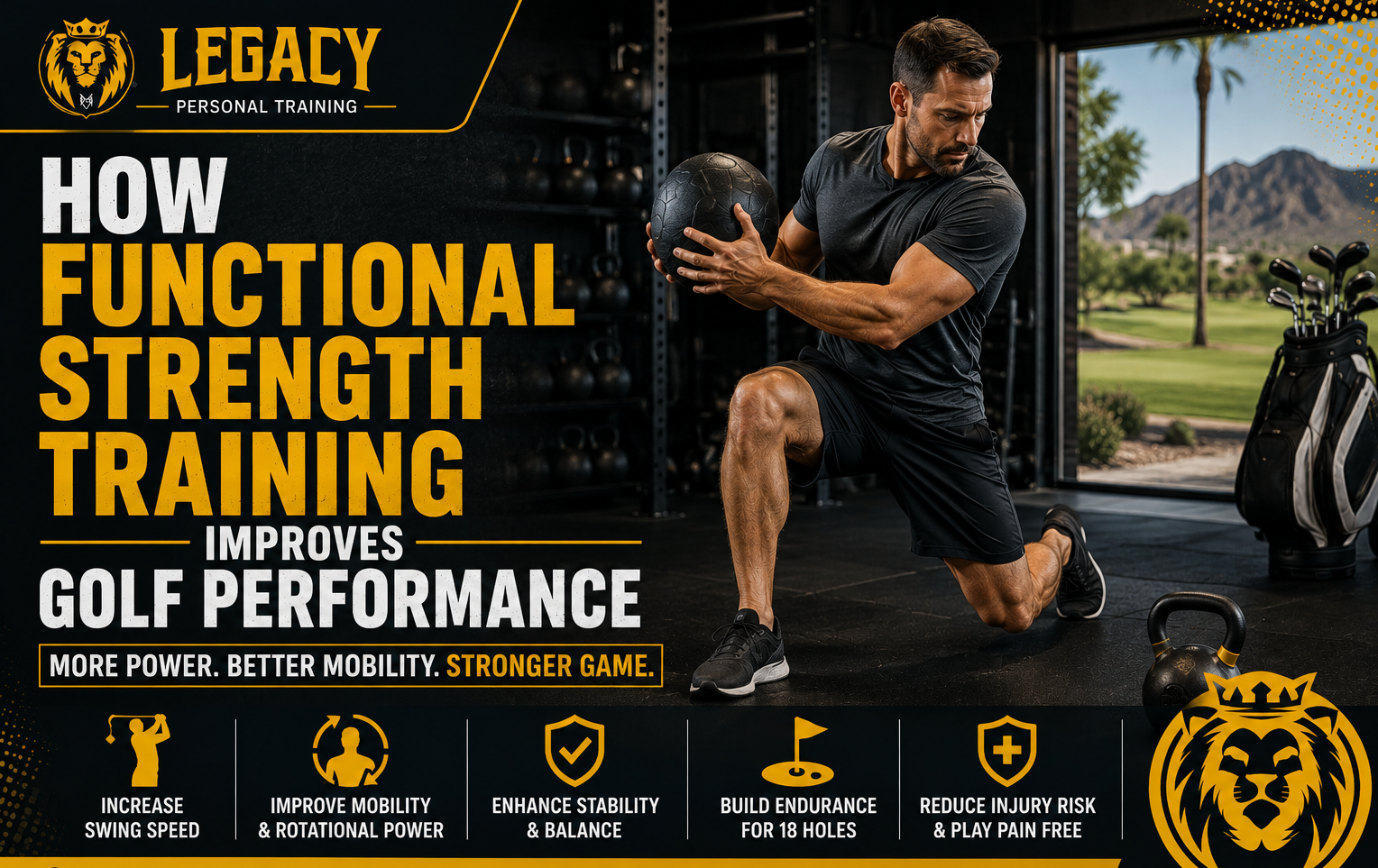
Golf may look effortless when watching the pros, but anyone who has played a round knows it’s a highly demanding sport. A powerful and consistent golf swing requires more than technique alone. It requires mobility, stability, strength, coordination, and endurance.
That’s why more golfers than ever are incorporating functional strength training into their fitness routines.
At Legacy Personal Training in Scottsdale, we work with many golfers who want to improve their performance on the course while reducing aches, pains, and injury risk. The goal isn’t to become a bodybuilder. The goal is to build a body that moves efficiently and can generate power consistently over 18 holes.
Why Golfers Need More Than Traditional Strength Training
Traditional gym programs often focus on individual muscle groups using machines and isolated exercises.
While there’s nothing inherently wrong with those exercises, golf is not played sitting on a machine.
Golf is a full-body movement that requires multiple joints and muscle groups to work together simultaneously. Every swing demands coordination between your hips, core, shoulders, and upper back while maintaining balance and control.
Functional strength training focuses on movement patterns rather than individual muscles. This approach better reflects the real demands of golf and helps create carryover from the gym to the course.
The Role of Rotational Power in Golf
One of the biggest goals for many golfers is increasing distance.
Distance isn’t created by swinging harder with your arms. It comes from generating force through the ground and transferring that force efficiently through your body and into the club.
This is where rotational power becomes critical.
Exercises such as:
- Medicine ball throws
- Cable rotations
- Rotational rows
- Split stance exercises
- Core stability drills
all help train the body to produce and transfer force more effectively.
The stronger and more coordinated your rotational mechanics become, the greater your potential swing speed.
Why Mobility Is Essential for a Better Golf Swing
Mobility limitations are one of the most common issues we see in golfers in the gym.
Restricted movement often forces the body to compensate during the swing, leading to inconsistent ball striking, reduced power, and increased injury risk.
Key areas golfers need to focus on include:
Thoracic Spine Mobility
The thoracic spine, or upper and mid-back, is responsible for much of the rotational movement required in golf.
When this area becomes stiff, golfers often compensate by overusing the lower back, which can contribute to pain and injury.
Hip Mobility
Efficient hip rotation is essential for generating power and maintaining proper swing mechanics.
Without adequate hip mobility, many golfers become overly reliant on their upper body and lose both distance and consistency.
Shoulder Mobility
The shoulders must move freely throughout the backswing and follow-through.
Limited shoulder mobility can reduce swing efficiency and increase stress on surrounding joints.
Stability and Balance Create Consistency
Power is important, but power without control rarely produces good results.
Balance and stability allow golfers to maintain proper positioning throughout the swing and make consistent contact with the ball.
Many golfers struggle because they are constantly making small compensations during their swing. These adjustments may seem minor, but they can dramatically affect performance.
Functional training incorporates single-leg exercises, core stability work, and balance challenges that improve body control and help create more repeatable swing mechanics.
Endurance Matters More Than Most Golfers Realize
Golf may not look physically demanding, but a typical round can last four to five hours.
During that time, golfers are:
- Walking long distances
- Repeatedly rotating their spine
- Maintaining posture
- Staying mentally focused
- Performing dozens of explosive swings
As fatigue sets in, mechanics often begin to break down.
This is why building overall work capacity and endurance is so important. Better fitness allows you to maintain your performance from the first tee to the final putt.
Injury Prevention for Lifelong Golf
Many people hope to play golf well into their 70s and 80s.
The best way to make that possible is by building a body that can tolerate the demands of the sport.
Functional strength training helps reduce injury risk by:
- Improving mobility
- Building strength around vulnerable joints
- Enhancing balance and coordination
- Increasing movement efficiency
- Reducing compensatory movement patterns
The result is not only better golf performance but also the ability to continue playing the game you love for years to come.
How Legacy Personal Training Helps Golfers in Scottsdale
At Legacy Personal Training, we don’t believe you need a separate “golf workout” for every golfer.
Instead, we focus on improving the qualities that every golfer needs:
- Mobility
- Rotational strength
- Stability
- Balance
- Endurance
- Injury resilience
Through our L.I.F.T. (Lifestyle Integrated Fitness Training) System, we help clients move better, build strength, and improve overall athletic performance while supporting long-term health and longevity.
Final Thoughts
The best golfers aren’t simply swinging harder.
They’re moving better.
Improving your mobility, rotational power, balance, stability, and endurance can help you hit the ball farther, improve consistency, and reduce injury risk both on and off the course.
If you’re looking to improve your golf performance while building a stronger, healthier body, functional strength training is one of the most effective investments you can make.
If you’re in Scottsdale or North Scottsdale and want to learn how strength training can improve your golf game, schedule a consultation with Legacy Personal Training and discover how our personalized coaching approach can help you perform better for years to come.