
You miss a few workouts.
You eat differently than planned over the weekend.
Work gets busy, you travel, or your normal routine gets disrupted.
And suddenly, it feels like you’ve fallen completely off track.
For many adults trying to improve their health, the biggest obstacle isn’t knowing that exercise, protein, hydration, and daily movement are important. The bigger challenge is believing that if you can’t do everything perfectly, there’s no point in doing anything at all.
That’s the all-or-nothing fitness mindset, and it can make sustainable progress much harder than it needs to be.
At Legacy Personal Training in Scottsdale, we see this frequently with adults who genuinely want to become stronger, improve their body composition, have more energy, and take better care of their long-term health.
The problem usually isn’t a lack of motivation.
It’s that they’ve been given an unrealistic picture of what being “consistent” is supposed to look like.
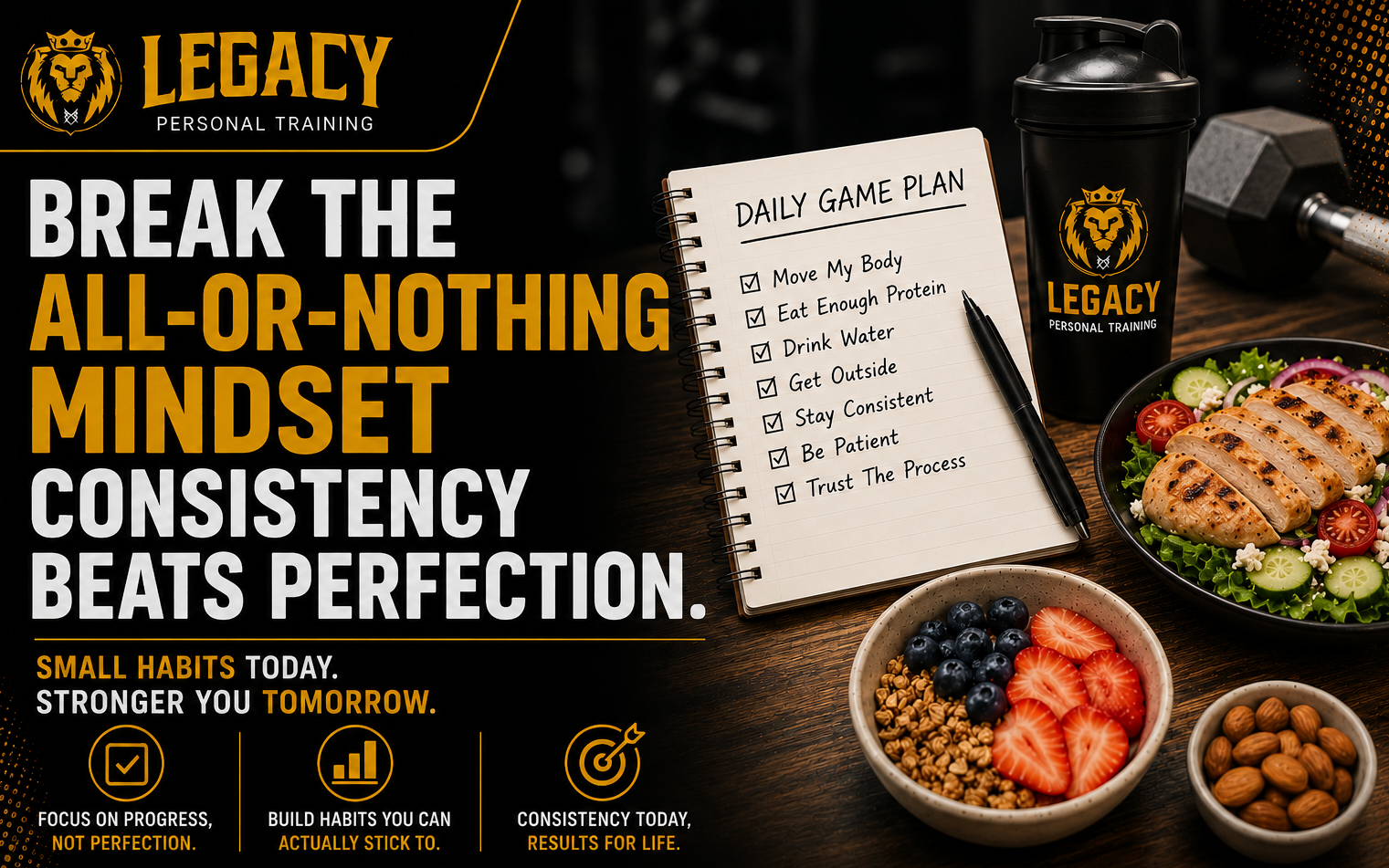
Sustainable fitness doesn’t require perfection. It requires building habits and systems that can survive real life.
What Is an All-or-Nothing Mindset in Fitness?
An all-or-nothing mindset happens when you believe a healthy habit only counts if you can do it perfectly.
It can sound like:
“I don’t have time to work out five or six days a week, so why bother starting?”
“I didn’t follow my nutrition plan this weekend, so I’ll start over Monday.”
“I don’t have time to meal prep everything for the week.”
“I missed several workouts, so I’ve already lost my progress.”
“I’m traveling, so there’s no way I can stay on track.”
The specific situation changes, but the underlying belief is the same:
If I can’t do it perfectly, it doesn’t count.
The problem is that life rarely gives us perfect conditions.
Work gets demanding. Vacations happen. Family responsibilities change. Energy fluctuates. Schedules get disrupted.
If your fitness routine only works when life is perfectly organized, it probably isn’t sustainable.
Consistency Beats Perfection in Fitness and Nutrition
One of the most important lessons we reinforce with clients at Legacy is simple:
Consistency beats perfection.
That doesn’t mean your choices don’t matter. It means you stop measuring success by whether every day went according to plan.
Instead, you focus on repeatedly making choices that move you in the right direction.
Two or three quality strength-training sessions each week performed consistently can be far more valuable than attempting an unrealistic six-day routine that you abandon after a few weeks.
The same principle applies to nutrition.
You don’t need seven flawless days of eating to make progress. You need enough supportive choices, repeated frequently enough, to create momentum over time.
That shift matters because long-term health isn’t built during one perfect week.
It’s built through hundreds of ordinary weeks.
Why Adults Over 40 Need a More Sustainable Approach to Fitness
As we get older, fitness becomes less about proving how hard we can push ourselves and more about building a body that continues to serve us well.
For adults over 40, strength training can be an important part of maintaining muscle, physical capacity, movement quality, and independence as the years go by.
But those benefits depend on your ability to keep training.
That makes sustainability incredibly important.
A workout program that looks impressive on paper but doesn’t fit your schedule isn’t necessarily a good program for you.
The better question is:
What can you realistically continue doing when life gets busy?
Maybe that means training three days per week instead of five.
Maybe it means shorter walks throughout the workday.
Maybe it means simplifying breakfast instead of completely overhauling your diet.
Your plan needs to work on normal Tuesdays, not just during the weeks when motivation is high and your calendar is empty.
Stop Relying on Willpower. Build Systems Instead.
Motivation can help you start.
Systems help you continue.
One of the ideas we emphasize in our coaching is systems over willpower.
Instead of repeatedly asking yourself to make the “right” decision, create an environment that makes the desired behavior easier.
For example, if you want to drink more water in the morning, fill your water bottle the night before and place it somewhere you already go every morning.
If you struggle to eat enough protein, don’t simply tell yourself to “try harder.” Identify a few reliable protein sources you enjoy, determine when you’re most likely to eat them, and make sure they’re readily available.
If you spend most of your workday sitting, create specific opportunities to move instead of hoping you’ll remember.
The goal is to reduce the amount of decision-making required.
Healthy behaviors become much easier to maintain when they are connected to routines you already have.
Start With Small Habits You Can Actually Repeat
When someone wants to change their health, it’s tempting to change everything at once.
New workout schedule.
New diet.
More water.
More steps.
Earlier bedtime.
Meal prep.
Less alcohol.
More protein.
Within days, the entire process can feel overwhelming.
Instead, start smaller.
Choose one meaningful behavior and become consistent with it.
Start With Breakfast
If you regularly skip breakfast and then find yourself extremely hungry later in the day, your first goal doesn’t necessarily need to be tracking every calorie you consume.
It might simply be:
Eat a balanced breakfast consistently.
Once breakfast becomes automatic, you can build from there.
Increase Your Protein Gradually
Many people know protein is important but struggle with consistently eating enough of it.
Rather than completely changing your diet overnight, look for opportunities to increase protein within meals you’re already eating.
You might start by improving breakfast.
Then lunch.
Then snacks.
Over time, those small improvements can significantly change your overall nutrition without requiring a restrictive diet.
Create Opportunities for Daily Movement
A structured workout is important, but it doesn’t erase an otherwise sedentary day.
Think about the typical routine of a busy professional:
You sit in the car on the way to work.
You sit at your desk.
You drive to the gym.
You train.
You drive home.
Then you sit down for the evening.
Even someone who exercises regularly can spend a significant amount of the day sedentary.
That’s why we encourage people to look for additional opportunities to move.
Take a short walk in the morning. Walk after lunch. Stand up between meetings. Take a brief movement break during the afternoon.
These don’t need to become formal workouts.
Think of them as small “exercise snacks” throughout your day.
What Should You Do When Life Disrupts Your Fitness Routine?
This is where moving away from all-or-nothing thinking becomes especially valuable.
Suppose you’re traveling and your normal workout and nutrition routines aren’t possible.
The all-or-nothing response is:
“I can’t follow my normal routine, so this week doesn’t count.”
A more sustainable approach asks:
What can I still do?
Maybe you can prioritize hydration.
Maybe you can include protein with your meals.
Maybe you can walk more.
Maybe you can complete one workout instead of your usual three.
The goal isn’t to recreate your perfect home routine while you’re away.
It’s to maintain enough of your habits that returning to your normal routine doesn’t feel like starting over.
This is an important distinction.
You don’t need to be perfect at maintaining momentum.
You simply need to avoid repeatedly abandoning it.
What Does Fitness Consistency Actually Look Like?
Consistency doesn’t mean doing the exact same thing every week.
In fact, for many adults, sustainable consistency requires flexibility.
One week, you may be able to train four times.
The next week, work gets busy and you train twice.
Both weeks can still be part of a consistent fitness lifestyle.
At Legacy Personal Training, this philosophy is built into our approach to training. Our L.I.F.T. methodology stands for Lifestyle Integrated Fitness Training because we believe fitness should integrate into your life rather than require your entire life to revolve around fitness.
The goal isn’t to create another obligation you’re constantly failing to keep up with.
It’s to create a structure you can return to again and again.
Accountability Makes Consistency Easier
Another important lesson we’ve seen through coaching is that sustainable change becomes easier when you aren’t trying to figure everything out alone.
Accountability isn’t about having someone criticize you when you aren’t perfect.
Good accountability helps you identify what worked, understand what didn’t, and decide what to do next.
A useful weekly check-in might include questions such as:
What went well this week?
What was difficult?
What got in the way?
What can we change to make the habit easier next week?
That approach replaces judgment with problem-solving.
It’s especially valuable when you’re surrounded by people experiencing similar challenges.
You realize you’re not the only person struggling to hit a protein target, stay active during a busy workweek, or rebuild a routine after traveling.
You can learn from what other people are doing while still creating a plan that fits your own lifestyle.
A Real Example of Why Returning Matters More Than Perfection
One of the stories shared in this episode of the Healthy Living Scottsdale podcast was about Legacy member Curtis.
During his initial time at Legacy, Curtis combined consistent workouts with nutrition coaching and experienced a significant physical transformation, losing more than 50 pounds.
Then life changed.
He stepped away from Legacy for a period of time.
That’s exactly where an all-or-nothing story could end: “I stopped, so I failed.”
But it didn’t.
Curtis eventually returned and rebuilt his consistency. At the time of the podcast episode, he had reached 300 workouts at Legacy.
That is a much more realistic picture of lifelong fitness.
There may be seasons when you’re extremely consistent and seasons when life pulls you away from your normal routine.
The important skill isn’t maintaining a perfect streak forever.
It’s learning how to return.
How to Get Out of an All-or-Nothing Mindset
If you’ve spent years repeatedly “starting over,” don’t respond by creating an even stricter plan.
Try simplifying instead.
Ask yourself:
- What is one healthy behavior I can realistically repeat this week?
- How can I make that behavior easier to do?
- What is my minimum acceptable version when life gets busy?
- What support or accountability would make consistency easier?
- What can I build on once this behavior becomes routine?
Your first step might be two strength workouts per week.
It might be drinking water before your morning coffee.
It might be eating a protein-rich breakfast.
It might be walking for ten minutes after lunch.
None of these behaviors look dramatic.
That’s the point.
You’re trying to create something repeatable.
Progress Over Perfection
You don’t need another fitness plan that works for three weeks.
You need an approach you can continue for years.
That means accepting that some weeks will be better than others. Vacations will happen. Work will become stressful. Motivation will fluctuate.
Your health doesn’t require you to navigate those situations perfectly.
It requires you to keep finding your way back to the behaviors that matter.
Progress over perfection. Systems over willpower. Consistency over intensity.
Those aren’t excuses to lower your standards.
They’re strategies for making your standards sustainable.
Looking for Sustainable Personal Training in Scottsdale?
At Legacy Personal Training in Scottsdale, Arizona, our goal is to integrate fitness into your life, not the other way around.
Our L.I.F.T. approach combines personalized strength training with movement assessment, progress tracking, nutrition coaching, mobility support, and individualized services designed around long-term health.
Whether you’re over 40 and looking to build strength, improve body composition, move better, rebuild consistency after time away from the gym, or simply find a fitness routine you can finally maintain, the goal is the same:
Build a stronger, healthier lifestyle that lasts.
Because fitness shouldn’t be something you repeatedly start and stop.
It should become part of how you live.
visit www.legacy.fitness/start to setup your consultation today