
Understanding the Basics of Supplements
Walk into a supplement store or spend five minutes scrolling through fitness content online and you can quickly feel like you need an entire cabinet of powders, pills, and capsules to get results.
Creatine. Protein powder. Magnesium. Fish oil. Vitamin D. Electrolytes. Collagen. BCAAs. Pre-workout. Fat burners.
Which supplements are actually worth considering?
And which ones are mostly unnecessary if you’re already eating well and strength training consistently?
For adults focused on building strength, maintaining muscle, recovering well, and supporting long-term health, the answer is usually much simpler than supplement marketing makes it seem.
At Legacy Personal Training in Scottsdale, we encourage people to think about supplements exactly as the name implies: they supplement the foundation. They don’t replace it.
Your strength training, nutrition, protein intake, hydration, sleep, recovery, and daily habits still do most of the heavy lifting.
Once those pieces are in place, certain supplements may help fill gaps or support your training.
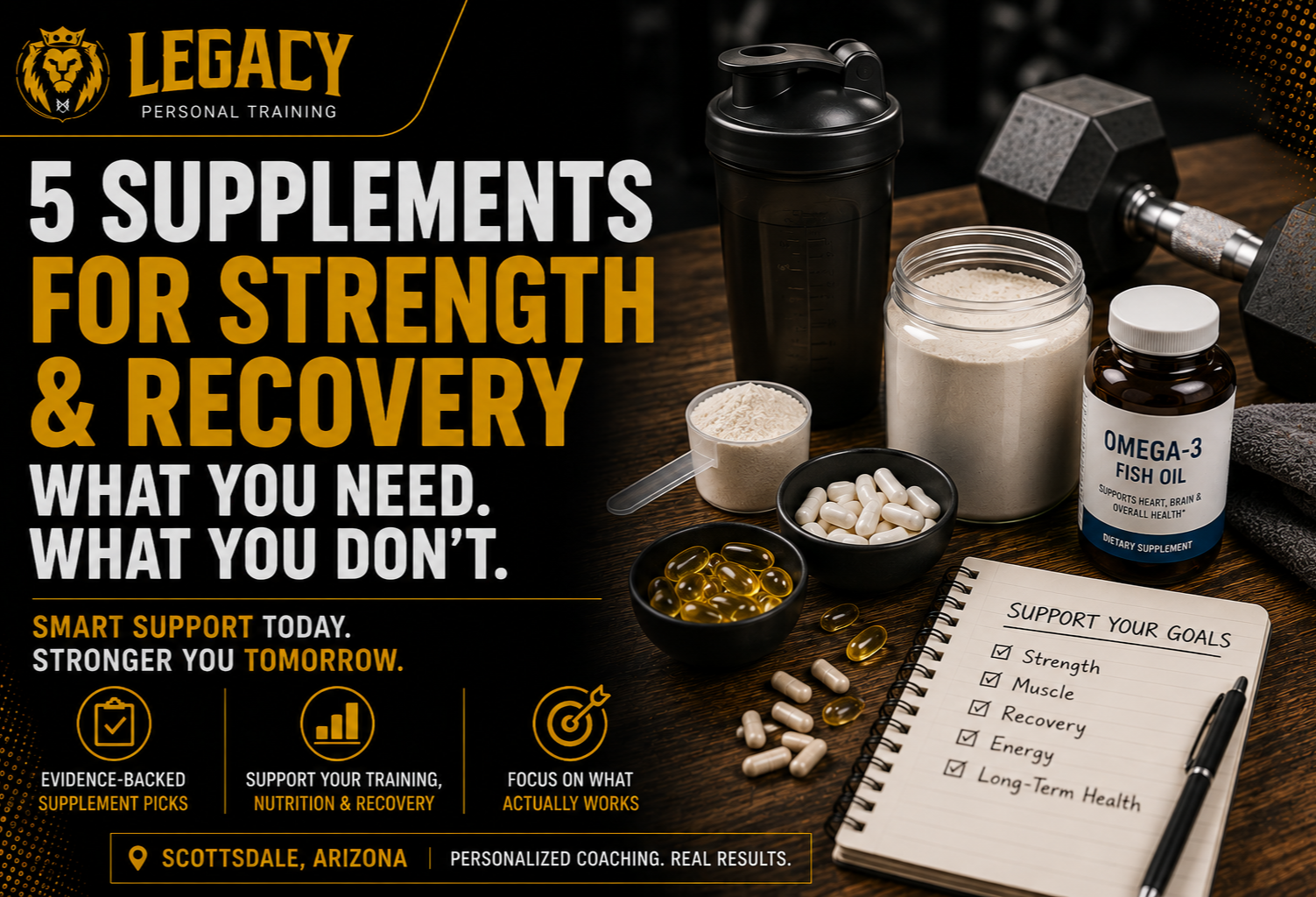
Here are five of the most commonly discussed supplements for active adults, plus a few others you may or may not need.
Do You Actually Need Supplements to Get Results From Strength Training?
No supplement can compensate for inconsistent training, poor nutrition, inadequate sleep, or a lifestyle that doesn’t support your goals.
That’s an important place to start.
If you’re looking for a powder or pill to do the work for you, you’re probably going to be disappointed.
But that doesn’t mean all supplements are useless.
Certain supplements can make it easier to meet nutritional needs or support performance and recovery. The key is understanding the difference between a useful supplement and something being marketed as a shortcut.
In a recent episode of the Healthy Living Scottsdale Podcast, Coaches Adam and Tara narrowed the conversation down to five of the supplements they hear about most often:
-
Creatine monohydrate
-
Protein powder
-
Vitamin D
-
Omega-3s
-
Magnesium
Let’s look at each one.
1. Creatine Monohydrate: A Popular Supplement for Strength and Muscle
If your goals include becoming stronger, improving training performance, or building and maintaining lean muscle, creatine monohydrate is one of the first supplements worth understanding.
Creatine helps support the body’s ability to rapidly produce energy during high-intensity activity, which is one reason it has become so popular in strength training.
What Does Creatine Do?
For someone who is consistently resistance training, creatine may support:
-
Strength and power
-
High-intensity exercise performance
-
Lean muscle development
-
Recovery between repeated efforts
Creatine has also attracted growing interest for potential benefits outside the gym, including cognitive function.
Does Creatine Cause Weight Gain or Bloating?
This is an especially common concern among women.
Creatine can increase water stored within muscle tissue. As a result, you may notice a change on the scale after beginning supplementation.
That’s an important distinction.
A higher number on the scale doesn’t automatically mean you’ve gained body fat.
If you’re using body-composition measurements, focus on trends and context instead of allowing one scale measurement to determine whether something is “working.”
How Much Creatine Should You Take?
A commonly used maintenance amount is approximately 3–5 grams of creatine monohydrate per day.
In the podcast, Coach Adam discusses using five grams consistently rather than making supplementation unnecessarily complicated with frequent cycling.
Creatine can be mixed into a protein shake or another beverage. Unflavored creatine is often the simplest option because it can easily be added to something you’re already consuming.
As with any supplement, individual circumstances matter, particularly if you have medical conditions, take medications, are pregnant, or have been advised to modify your diet or supplementation.
2. Protein Powder: A Convenient Way to Reach Your Protein Goal
Protein powder isn’t magic.
It’s convenient protein.
That’s precisely why it can be so useful.
Protein plays an important role in muscle repair and maintenance, making adequate intake especially relevant for adults who strength train and want to preserve lean mass as they age.
The challenge is that getting enough protein entirely through whole foods isn’t always easy.
You may reach the end of the day and realize you’re significantly below your target. Or you may simply be tired of eating.
A shake can make closing that gap much easier.
Do You Need Protein Powder to Build Muscle?
No.
You can absolutely get protein from whole-food sources.
Protein powder becomes useful when convenience is the difference between consistently meeting your nutritional needs and repeatedly falling short.
Think of it as a tool rather than the foundation of your diet.
How Can You Eat More Protein Throughout the Day?
Instead of waiting until dinner to realize you’re behind, distribute protein across your day.
That might mean including a meaningful protein source at breakfast, lunch, and dinner, then using a shake or high-protein snack when needed.
For example:
Breakfast: Eggs, Greek yogurt, cottage cheese, or another protein-rich option.
Lunch: Chicken, fish, lean meat, tofu, or another protein source.
Snack or post-workout: Protein shake.
Dinner: Another whole-food protein source.
The exact amount someone needs varies based on factors including body size, activity, goals, age, and health status. The important takeaway isn’t that everyone needs the same number.
It’s that consistently getting enough protein matters more than simply owning a tub of protein powder.
3. Vitamin D: Important for More Than Bone Health
Vitamin D plays a role in several important physiological functions, including bone health and muscle function.
And living somewhere sunny doesn’t necessarily guarantee that your vitamin D status is optimal.
That’s relevant here in Scottsdale.
We may live in Arizona, but many people still spend most of their days indoors: working at a desk, driving, exercising inside, and avoiding prolonged exposure during the hottest parts of the day.
What About Vitamin D3 and K2?
You’ll frequently see vitamin D3 sold alongside vitamin K2.
The two nutrients have distinct roles related to calcium and bone metabolism, which is one reason they are commonly paired in supplement products.
However, vitamin D is also a good example of why supplements shouldn’t always be approached with a blanket “everyone should take this” mentality.
Your needs can vary considerably.
If vitamin D status is a concern, testing and discussing the results with a qualified healthcare professional can give you a much better answer than guessing based on a social media recommendation.
4. Omega-3s: Supporting Heart Health and More
Omega-3 fatty acids are another commonly discussed supplement, particularly when someone doesn’t regularly consume fatty fish and other omega-3-rich foods.
Omega-3 fatty acids are associated with cardiovascular health and have roles throughout the body, including in the brain and inflammatory processes.
For active adults, that makes omega-3 intake particularly interesting as part of a broader recovery and longevity strategy.
But remember the same principle we’ve applied to every supplement so far:
Food first when practical. Supplement when useful.
If your diet already includes appropriate omega-3-rich foods regularly, your situation may be different from someone who rarely consumes them.
5. Magnesium: Sleep, Muscle Function, and Recovery
Magnesium is involved in hundreds of processes throughout the body and plays a role in normal muscle and nervous-system function.
It’s also become increasingly popular as part of an evening routine because of its relationship with relaxation and sleep.
And sleep matters enormously when you’re strength training.
You don’t become stronger simply because you completed a hard workout.
Training provides the stimulus.
Your body then needs nutrition and recovery to adapt to that stimulus.
Why Sleep Should Come Before “Recovery Hacks”
If you’re regularly sleeping five hours per night, buying more recovery supplements probably isn’t the first problem to solve.
Start with your sleep habits.
Look at your schedule, environment, caffeine intake, bedtime routine, and consistency.
A supplement should complement those behaviors rather than become an attempt to compensate for them.
What About Electrolytes?
Here in Scottsdale, this conversation deserves extra attention.
During the Arizona summer, heat and sweat can substantially increase fluid and electrolyte losses, particularly for people exercising outdoors or spending significant amounts of time in the heat.
And hydration isn’t only about drinking plain water.
Electrolytes such as sodium play important roles in fluid balance and normal physiological function.
That doesn’t mean everyone needs to carry an electrolyte drink everywhere they go. But if you’re sweating heavily during training or spending substantial time outside in the Scottsdale heat, your hydration strategy may need to account for more than water alone.
What About Caffeine Before a Workout?
Caffeine can improve alertness and exercise performance for many people, which is why it’s included in so many pre-workout products.
But more isn’t automatically better.
If caffeine disrupts your sleep, makes you jittery, raises your anxiety, or leaves you dependent on increasingly large doses just to get through a workout, the tradeoff may not be worthwhile.
This becomes particularly important when someone trains later in the day.
A great workout followed by a terrible night’s sleep isn’t necessarily a win for recovery.
Is Collagen Worth Taking?
Collagen is commonly marketed for joints, connective tissue, skin, hair, and nails.
For someone specifically concerned about connective-tissue health or who has been advised to use collagen, it may have a place.
But it shouldn’t be confused with a complete replacement for adequate dietary protein.
If your fundamental nutrition and protein intake are inconsistent, those are generally more important places to begin.
Do You Need BCAAs If You Already Eat Enough Protein?
For many people who already consume adequate high-quality protein, standalone branched-chain amino acid supplements are unlikely to be the highest-priority purchase.
Why?
Because complete protein sources already provide the essential amino acids your body needs.
This is another example of supplement marketing making something appear more complicated than it needs to be.
Before buying another amino acid product, ask a simpler question:
Am I consistently eating enough protein?
If the answer is no, fix that foundation first.
What About Fat Burners and Testosterone Boosters?
These are categories where skepticism is especially useful.
Fat Burners
No “fat-burning” supplement eliminates the need for the behaviors that actually drive body-composition change.
If your goal is fat loss, focus first on sustainable nutrition, strength training, daily activity, adequate protein, sleep, and consistency.
The bottle isn’t going to do those things for you.
Testosterone Boosters
Hormonal health is not something to guess about based on a supplement advertisement.
If you’re concerned about testosterone or other hormones, that’s a conversation for appropriate testing and qualified medical guidance.
At Legacy, we believe objective information and individualized recommendations are much more useful than throwing supplements at a problem you haven’t identified.
Supplements Should Support Your Training, Not Replace It
Here’s where people often get the order wrong.
They start by asking:
“What supplements should I take?”
A better sequence of questions is:
Am I strength training consistently?
Am I eating enough protein and nutrient-dense food?
Am I sleeping and recovering adequately?
Am I staying hydrated?
Am I moving enough outside the gym?
Do I have an identified nutritional need or gap?
Then you can ask:
Would a supplement make any of those things easier or more effective?
That’s a very different mindset.
A Simple Supplement Strategy for Adults Over 40
If you’re over 40 and trying to become stronger, preserve muscle, improve body composition, and stay active for decades to come, don’t let your supplement routine become more complicated than your training routine.
Start with the big rocks:
Strength train consistently. Maintaining and building muscle becomes increasingly valuable as you age.
Prioritize protein. Give your body the nutritional resources it needs to maintain and repair muscle.
Eat a well-rounded diet. Supplements can’t reproduce everything you get from quality whole foods.
Hydrate appropriately. Especially if you’re training in Arizona.
Sleep. Your body needs time to recover and adapt.
Use supplements strategically. Creatine and protein powder are two common examples that may directly complement a strength-training lifestyle, while other supplements should depend more heavily on diet, individual needs, testing, and professional guidance.
The Bottom Line: You Probably Don’t Need a Cabinet Full of Supplements
The supplement industry can make health feel incredibly complicated.
It doesn’t have to be.
For most people, the biggest improvements aren’t going to come from discovering the ninth supplement to add to their morning routine.
They’re going to come from consistently doing the fundamentals well.
Train.
Eat enough protein.
Eat nutritious foods.
Move.
Hydrate.
Sleep.
Recover.
Then supplement where it makes sense.
At Legacy Personal Training in Scottsdale, Arizona, our focus is helping adults build strength, improve body composition, move better, and create a fitness lifestyle they can maintain for the long term.
Our L.I.F.T. approach is built around integrating fitness into your life rather than chasing short-term fixes. That means personalized strength training, movement quality, nutrition support, progress tracking, recovery, and sustainable habits all work together.
Because the goal isn’t simply to optimize your next workout.
It’s to build a body that stays strong and capable for life.
Supplement needs vary by individual. If you have a medical condition, take medication, are pregnant or nursing, or are considering supplements to address a deficiency or health concern, discuss them with an appropriate healthcare professional.