
Starting a new fitness program can be exciting. It can also be intimidating.
What will my first workout be like?
How many days a week should I train?
Should I eat before my workout?
How long will it take before I see results?
And am I supposed to be doing more exercise on the days I’m not at the gym?
At Legacy Personal Training in Scottsdale, these are some of the most common questions we hear from new members, and they’re good questions.
The problem is that many people walk into a new fitness program thinking they need to immediately overhaul their entire lives.
Six workouts a week. A completely different diet. More cardio. Fewer carbs. Earlier mornings. More supplements.
That’s rarely necessary.
Especially for adults over 50, the goal shouldn’t be to see how much exercise you can survive during your first month. It should be to establish a sustainable routine that helps you get stronger, improve your body composition, move better, and continue making progress for years.
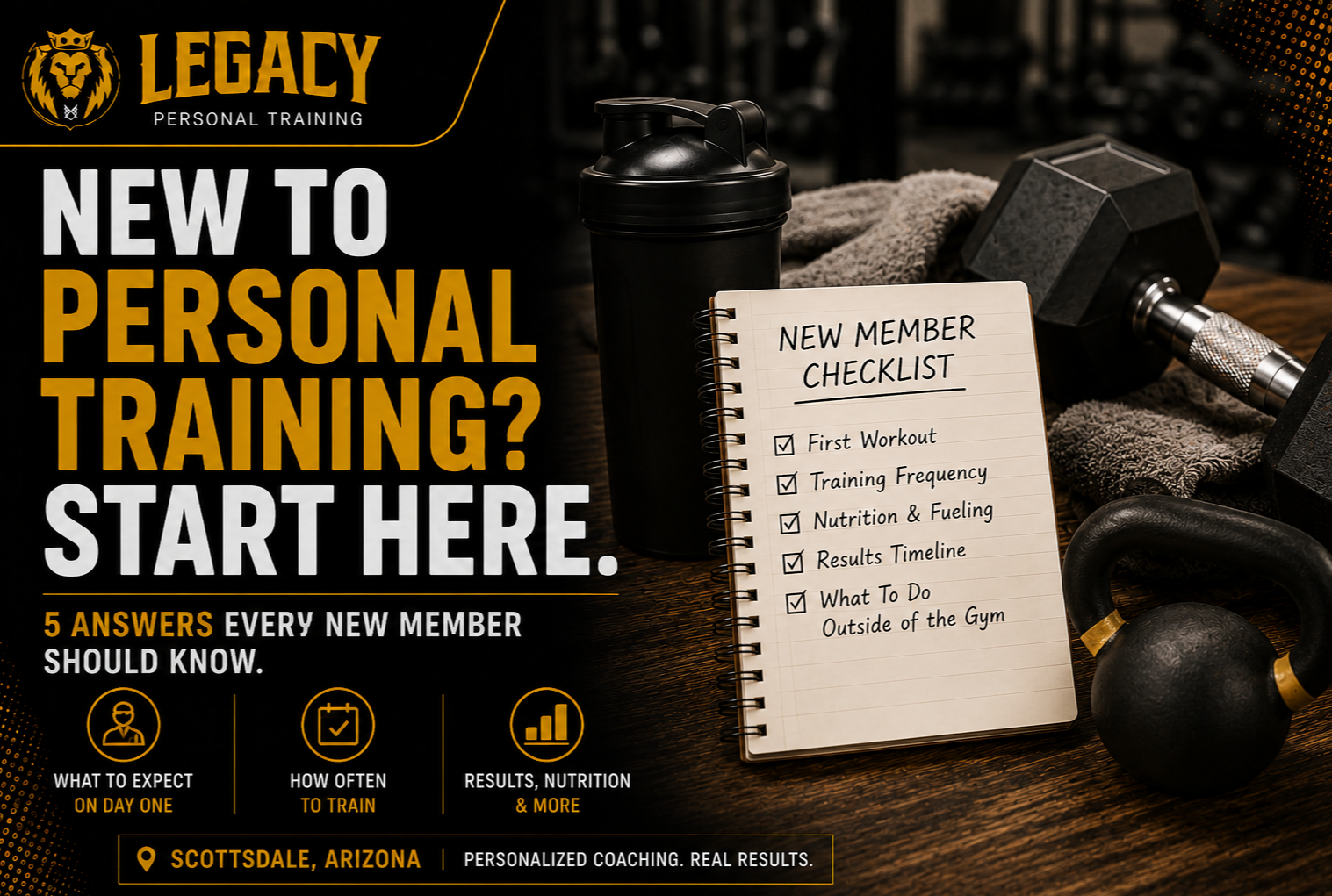
So, if you’re thinking about starting with us at Legacy Personal Training, here are five questions that you may have.
1. What Should I Expect at My First Training Session?
First, you shouldn’t be expected to walk into a gym already knowing what to do.
That’s what coaching is for.
One of the biggest concerns we hear from new members is some version of:
“Am I actually going to be able to do this?”
For someone who hasn’t exercised in years, or perhaps has never consistently trained in a gym, walking into a room filled with weights and unfamiliar equipment can be intimidating.
A good personal training program should account for that.
How New Members Start at Legacy Personal Training
At Legacy, new members begin with our Body Mapping Phase.
Rather than immediately throwing you into a difficult workout and seeing whether you can keep up, the first couple of weeks are designed to establish where you’re starting.
You’re learning the equipment.
You’re learning the flow of the workout.
Your coaches are learning how you move.
And you’re building confidence.
During this period, our coaches assess your movement across dozens of movement patterns and use that information to determine appropriate exercise progressions.
That means your starting point isn’t based on what the person next to you can do.
It’s based on what you can do today.
That’s an important distinction.
Maybe you were incredibly strong 15 years ago.
Maybe you’ve never lifted a weight.
Maybe you’ve had an old shoulder issue and haven’t felt comfortable strength training since.
Your program should meet the person who walks through the door today, not the person you were years ago.
2. How Many Days a Week Should a Beginner Work Out?
There isn’t one perfect number.
For many adults, two to four strength-training sessions per week can be a realistic range, depending on training experience, schedule, recovery, and goals.
But there’s another factor that matters just as much:
What can you consistently maintain?
If you’ve barely exercised during the past year, committing yourself to six days a week because you’re excited about starting isn’t necessarily the best strategy.
You may sustain it for two weeks.
Then three.
Then work gets busy, soreness accumulates, motivation drops, and suddenly you’re doing nothing.
That’s exactly what we want to avoid.
Start by Establishing Consistency
Suppose your schedule realistically allows you to train Tuesday and Thursday every week.
Start there.
Two workouts you complete consistently are more valuable than planning six and regularly completing two.
Once you’ve established that rhythm, you can always build from it.
This is one reason our L.I.F.T. philosophy stands for Lifestyle Integrated Fitness Training.
Your fitness program needs to fit into your actual life.
Not your imaginary life where work is never stressful, nobody travels, your family never needs anything, and your schedule always goes according to plan.
Can You Strength Train on Consecutive Days?
Another common misconception is that you always need a complete day off between workouts.
Not necessarily.
Program design matters.
If your training is structured appropriately, consecutive training days may be possible because your coaches can manage exercise selection, training stress, muscle groups, and progression.
At the same time, recovery still matters.
You need opportunities for muscles and your overall system to recover from training. Learning to recognize fatigue, soreness, and changes in performance is part of becoming more experienced with exercise.
The goal is not to train as often as possible.
It’s to train frequently enough to make progress while recovering well enough to keep doing it.
3. What Should You Eat Before a Workout?
The answer depends heavily on when you train.
Someone working out at 5 a.m. has a very different situation from someone training at 5 p.m.
That’s why generic nutrition rules often aren’t very helpful.
Carbohydrates and Training Energy
Carbohydrates are an important energy source during exercise, particularly as training intensity increases.
If you’re training later in the morning and haven’t eaten since the previous evening, having some easily digested carbohydrate before your workout may help you feel and perform better.
That doesn’t mean you need a huge meal immediately before training.
Timing and tolerance matter.
For someone training later in the day, a balanced meal several hours beforehand may provide plenty of energy.
The bigger point is this:
Your nutrition should support your training rather than follow arbitrary rules.
What About Fasted Workouts?
Some people enjoy training early in the morning without eating first, while others feel terrible doing it.
There’s no prize for making your workout unnecessarily difficult.
If training fasted leaves you lightheaded, sluggish, or unable to perform well, that’s useful information.
Your coaches can help you experiment with meal timing and food choices that better support your schedule and goals.
Don’t Overcomplicate Nutrition When You’re Starting
When someone joins us at Legacy, there’s often an urge to change everything about their diet immediately.
That usually isn’t necessary! Instead, begin by understanding what you’re currently doing.
Nutrition tracking during your first couple of weeks helps provide a snapshot of your normal habits.
You don’t necessarily need to obsessively track every calorie to learn something useful.
For example, tracking your protein intake for three or four normal days can tell you a lot.
Are you consistently eating protein?
Are you getting almost all of it at dinner?
Are there meals where you’re barely eating any?
Before changing your diet, understand your starting point.
4. How Long Does It Take to See Results From Personal Training?
This may be the most common question of all.
And the answer depends on what you mean by results.
If the only result you’re willing to recognize is a dramatic physical transformation, you may overlook a lot of progress that’s already happening.
You May Feel Results Before You See Them
Some of the earliest signs that your fitness program is working can include:
- More energy
- Better confidence in the gym
- Improved mobility
- Better exercise technique
- Increased strength
- Better sleep
- Less difficulty completing everyday physical tasks
- Greater consistency with healthy behaviors
None of those necessarily produce a dramatic before-and-after photograph during week two, but they matter.
Imagine someone who was nervous walking into the gym on day one.
A few weeks later, that same person knows where the equipment is, understands the exercises, recognizes their coaches, and feels confident picking up weights they wouldn’t have touched before.
That’s progress.
Physical Changes Take Time
Changes in muscle mass and body composition require consistent training, nutrition, recovery, and time.
How quickly they occur varies significantly between individuals.
That’s why promising that everyone will see a particular result in 30 days doesn’t make much sense.
Instead of asking only:
“How fast can I reach my goal?”
Ask:
“What happens after I reach it?”
If your approach is so restrictive or demanding that you can’t maintain it, you’ll eventually find yourself starting over again.
The better goal is to create a lifestyle that allows the results to stay with you.
A useful way to think about progress is:
First, you feel it. Then, you see it. Eventually, other people may notice it too.
Don’t ignore those early wins simply because the scale hasn’t moved as quickly as you hoped.
5. What Should You Do Outside of Your Personal Training Sessions?
Let’s say you strength train three times per week. That’s about three dedicated hours to strength training and moving your body.
There are still a lot of hours left in your week.
Your workouts are important, but what you do outside the gym matters too.
You Don’t Necessarily Need More Hard Workouts
The answer isn’t automatically to add another intense workout every day.
Instead, think about daily movement and active recovery.
That could include:
- Walking
- Swimming
- Hiking when Scottsdale weather allows
- Biking
- Recreational sports
- Golf
- Mobility work
- Appropriate cardiovascular exercise
- Simply getting up and moving more throughout your workday
For many busy professionals, this last one is particularly important.
You can complete a great workout in the morning and still spend most of the remaining day sitting.
You drive to work.
Sit at a desk.
Drive home.
Sit during dinner.
Sit on the couch.
That’s why we encourage people to think beyond formal exercise.
Move More Throughout Your Day
If you work at a desk, look for opportunities to break up long periods of sitting.
Walk between meetings.
Take a short walk after lunch.
Stand while you’re on a phone call.
Go outside for ten minutes.
These actions aren’t replacements for strength training.
They’re part of building a more active lifestyle.
And that’s ultimately the point.
What Should a Good Personal Training Program Look Like for Adults Over 50?
As you get older, your training needs to accomplish more than simply making you tired.
It should help you build and maintain strength.
It should improve your ability to move.
It should account for your training history and current limitations.
It should provide appropriate progression.
And most importantly, it should be something you can continue doing.
At Legacy Personal Training, our approach starts with assessment rather than assumption.
Our Body Mapping process helps establish a baseline, while our L.I.F.T. methodology provides a structured path through mobility and stability, strength and muscle development, and higher-level performance as appropriate for the individual.
That personalization matters because two 50-year-olds can walk into the same gym with completely different bodies, backgrounds, injuries, schedules, and goals.
They shouldn’t automatically receive identical training.
You Don’t Have to “Get in Shape” Before Starting Personal Training
You don’t need to become fitter before you’re ready for coaching.
You don’t need to lose weight first.
You don’t need to know how gym equipment works.
And you don’t need to prove that you can survive a hard workout.
A good coach should meet you where you are and help you progress from there.
For some people, that starting point is rebuilding strength after years away from exercise.
For someone else, it’s learning how to move confidently without aggravating an old injury.
For another person, it’s taking an already solid fitness foundation and improving strength or performance.
Different starting points.
Same principle: Start where you are. Progress from there.
The Goal Is Fitness for Life, Not Just Right Now
The first few weeks of a fitness program matter, but they’re not the goal. The goal is what you’re still doing a year from now.
Five years from now.
Ten years from now.
That’s why consistency matters more than an aggressive start.
Train enough to create progress.
Eat in a way that supports your goals.
Recover.
Stay active outside the gym.
Pay attention to the small wins.
And give your body enough time to adapt.
At Legacy Personal Training in Scottsdale, Arizona, we help adults build strength, improve body composition, move better, and create a fitness routine that integrates into real life.
Our personalized L.I.F.T. training system, Body Mapping process, ongoing progress tracking, nutrition support, and coaching are designed around one larger objective:
Helping you build a stronger, healthier body you can rely on for life. Because the best fitness program isn’t the one you can survive for 30 days. It’s the one you can continue for life.