
Understanding Strength and Aging
Turning 50 has a way of changing how you think about fitness.
For many people, the goal is no longer simply to look better in a swimsuit, lift the most weight in the gym, or chase the body they had in their 20s. Those things may still matter, but another question starts becoming increasingly important: Is my body strong enough to keep doing the things I want to do for the next 20, 30, or 40 years?
That’s where functional strength becomes important.
At Legacy Personal Training in Scottsdale, we work with adults who want to stay strong, active, independent, and capable as they get older. Some have trained for decades. Others walk through our doors at 50, 60, or even 70 after years away from structured exercise. Their starting points may be completely different, but the long term objective is often very similar.
They want their bodies to keep working for them.
So how strong should you actually be after 50? There is no single number that answers that question. Your strength should be measured against the demands of your life, your goals, your current abilities, and the things you want to continue doing as you age.
What Does Being Strong After 50 Actually Mean?
When people hear the word strength, they often picture barbells, heavy dumbbells, or someone trying to set a personal record in the gym. Those can certainly be expressions of strength, but they are only part of the picture.
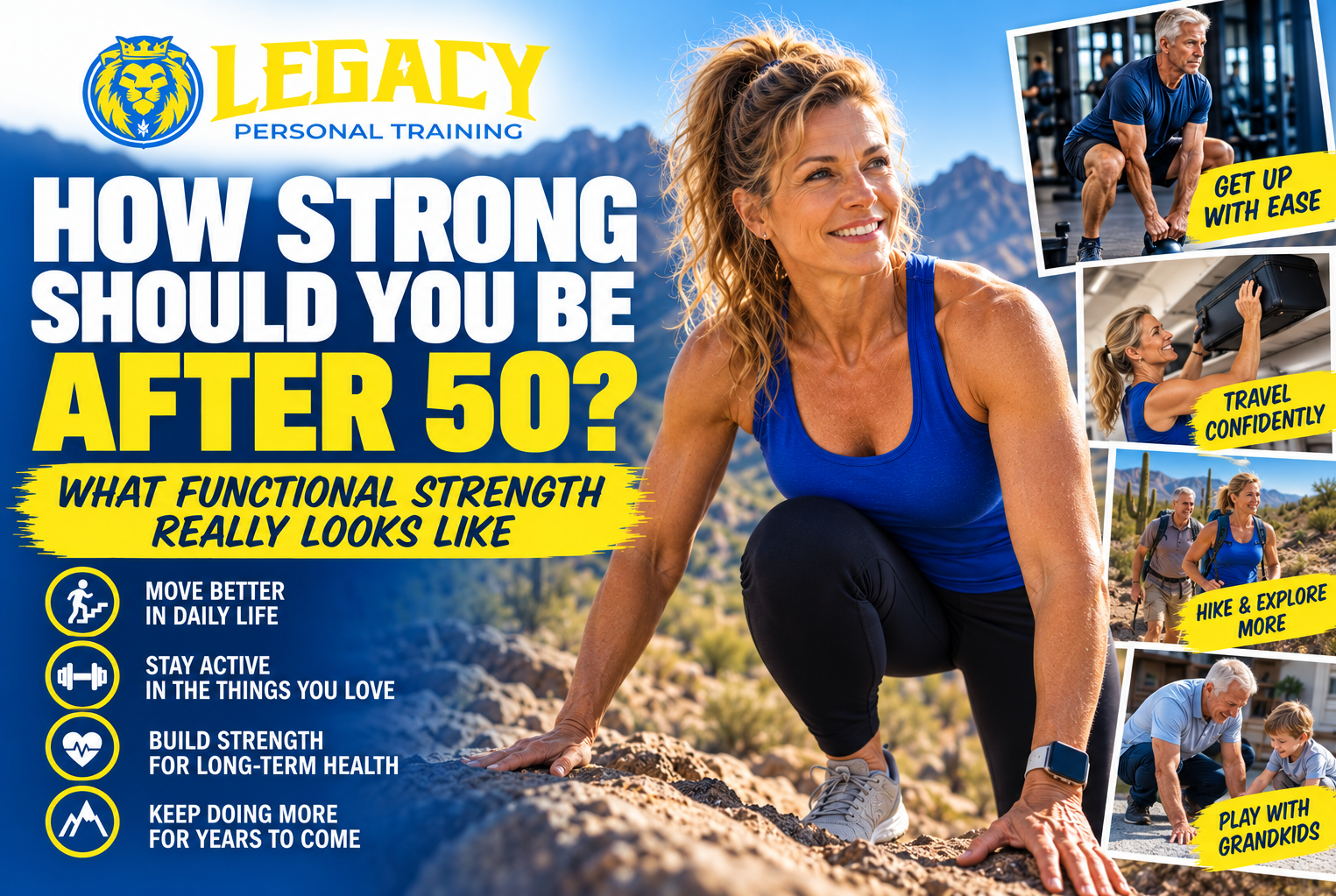
Functional strength is your ability to produce and control force in ways that help you navigate everyday life. It is getting out of a chair without needing your hands. It is carrying groceries from the car, picking something up from the floor, putting a suitcase into an overhead compartment, climbing stairs, maintaining your balance when you step off a curb, and getting down onto the floor and back up again.
For someone living in Scottsdale, functional strength might also mean being able to hike, play golf, enjoy pickleball, travel, work around the house, or spend an active day with family without worrying about whether your body can handle it.
That is why asking, “How much should a 50 year old be able to squat?” isn’t necessarily the most useful question.
A better question is: “Do I have enough strength for the life I want to live?”
Why Does Strength Matter More After 50?
Strength has always mattered, but maintaining it becomes increasingly important as we get older.
Muscle provides much more than appearance. It helps us produce force, stabilize joints, maintain balance, perform everyday activities, and preserve physical independence. Strength training also places an important stimulus on the body that helps us maintain the muscle and physical capacity we have worked to build.
This is one reason we encourage adults over 50 to stop thinking about exercise exclusively as a tool for burning calories.
The calorie burn from a workout is not the most important thing strength training gives you.
The bigger return is adaptation. You are giving your body a reason to maintain and potentially build muscle, improve strength, become more coordinated, and handle physical demands more effectively.
If you want to be capable at 70, building and maintaining that capacity at 50 is a pretty good place to start.
The Everyday Strength Tests That Actually Matter
You do not need to turn your life into a fitness test or compare your performance with everyone else your age. However, there are everyday movements that can tell you quite a bit about your current physical capacity.
Instead of worrying about arbitrary strength standards, start paying attention to how confidently you can perform the movements life regularly asks of you.
Can You Get Up From a Chair Without Using Your Hands?
Standing up from a seated position seems incredibly simple until it isn’t.
Think about what actually has to happen. Your legs need to produce enough force to lift your body. Your hips and knees need to move through an appropriate range of motion. Your trunk needs to remain controlled, and you need enough balance to transition safely from sitting to standing.
If you regularly need your arms to push yourself out of a normal chair, that may be a sign that lower body strength deserves more attention.
This does not mean you have failed some universal fitness test. It simply gives you useful information about an ability that matters tremendously for long term independence.
Squats, split squats, step ups, deadlift variations, and other appropriately selected strength exercises can help train many of the qualities involved in getting up and down confidently.
Can You Get Down on the Floor and Back Up?
This is another movement that many younger adults take for granted.
As people get older, some gradually stop getting onto the floor altogether. Sometimes it is because of knee discomfort. Sometimes it is fear of not being able to get back up. In other cases, it simply hasn’t been practiced in years.
Getting down and back up requires a combination of strength, mobility, coordination, and balance.
That makes it a valuable real world ability.
If playing with your grandchildren, gardening, exercising, working around the house, or simply being confident in your own body matters to you, being able to transition between the floor and standing is worth maintaining.
You don’t necessarily need to perform it in one particular way. What matters is having the physical options to safely get yourself down and back up.
Can You Carry Something Heavy?
Life requires carrying things.
Groceries. Suitcases. Boxes. Laundry baskets. Golf bags. Grandchildren.
Your ability to carry weight depends on more than your arms. Your grip, shoulders, upper back, core, hips, and legs all contribute.
Loaded carries are one reason strength training has such an obvious connection to everyday life. Walking while holding appropriately challenging weights can help train grip strength, posture, trunk stability, and overall work capacity.
A good strength program should make normal objects feel easier to handle.
That is one of the simplest ways to recognize progress. The weight you lift in the gym matters, but so does what that strength allows you to do outside of it.
Can You Pick Something Up From the Ground?
Picking something up from the floor is another movement that seems basic until people begin avoiding it.
Maybe your back bothers you. Maybe your hips feel tight. Maybe you have been told that bending over is dangerous, so you become hesitant every time something falls on the floor.
The ability to hinge at the hips, control your trunk, bend your knees appropriately, produce force through your lower body, and return to standing is fundamental.
This is one reason deadlift variations can be so valuable when they are taught and programmed appropriately. The purpose is not necessarily to see how much weight you can lift from the ground. The purpose is to build strength in a movement pattern you will use throughout your life.
Your training should make everyday movement feel more manageable, not more intimidating.
Can You Climb Stairs Without Feeling Weak or Unsteady?
Stairs are one of the easiest places to notice changes in physical capacity.
Walking up stairs requires your legs to repeatedly lift your body weight against gravity. Walking down requires control, balance, and the ability to manage force as your body lowers from one step to the next.
If stairs have gradually become more difficult, it can be tempting to simply avoid them.
The problem with avoidance is that your body adapts to what you ask it to do. If you continually remove physical challenges from your life, you may become less prepared to handle them.
Strength training can help you maintain the lower body strength required for stairs, hills, hiking, and other activities that require you to move your own body weight.
That matters in Scottsdale, where an active lifestyle might include everything from climbing stadium steps to hiking local trails.
Can You Balance on One Leg?
Strength and balance are closely connected.
Standing on one leg may sound like a simple balance exercise, but your body is doing quite a bit of work. The muscles around your foot, ankle, knee, hip, and trunk all have to coordinate to keep you stable.
Balance can become more challenging with age, but that does not mean you should simply accept becoming unsteady.
It is a quality that can be trained.
Good strength programs can include unilateral exercises, which are movements that challenge one side of the body at a time. Split squats, step ups, single leg variations, carries, and other exercises can help develop strength while also challenging stability and coordination.
At Legacy, this is one reason we look beyond how much weight someone can move. How you control your body matters too.
Can You Put Your Luggage in the Overhead Compartment?
This might be one of the best functional strength tests because it represents something many people actually want to continue doing.
Travel requires more physical capacity than we sometimes realize.
You may need to walk through a large airport, carry luggage, lift a suitcase overhead, sit for several hours, stand back up, navigate stairs, and then spend days walking around a destination.
Being physically prepared for those demands can completely change the way you experience a trip.
Upper body strength matters here, but so does trunk stability, shoulder mobility, coordination, and confidence.
This is the kind of outcome that can be far more meaningful than simply knowing how much weight you can press on a machine.
You are not training just to become better at the gym.
You are training so the gym makes you better at life.
Can You Handle a Full Day of Activity?
Strength is important, but functional fitness is not strength alone.
You could be very strong for a few repetitions and still struggle with an entire day of walking, traveling, hiking, or recreational activity.
That is why a well rounded approach to fitness should also consider cardiovascular health, muscular endurance, mobility, balance, and recovery.
Imagine spending the day walking through a new city on vacation. You might be on your feet for several hours, climb stairs, carry bags, sit down for lunch, get back up, and continue moving into the evening.
Can your body handle that without the experience becoming miserable?
That is fitness too.
For adults over 50, the goal should not simply be improving individual numbers inside the gym. It should be developing enough overall capacity that your body does not become the limiting factor in the things you want to experience.
How Much Weight Should You Be Able to Lift After 50?
This is where we need to be careful with fitness standards.
There are strength benchmarks based on body weight, age, sex, and training experience, but those numbers do not tell the whole story.
A healthy 52 year old who has strength trained consistently for 20 years should not necessarily be compared with a 52 year old who is returning to exercise after a decade away. Someone with a history of knee surgeries may require a different training approach than someone without that history.
Age matters, but it is only one piece of the puzzle.
Instead of asking whether you can lift the amount an online chart says you “should” lift, pay attention to whether your strength is improving relative to your own starting point.
Can you squat more comfortably than six months ago? Can you carry heavier weights? Can you perform an exercise with better control? Can you climb stairs more easily? Can you get off the floor more confidently?
Those improvements matter.
Your goal should not be to win a comparison against other 50 year olds. Your goal should be to increase your own physical capacity.
Strength Is More Than Your Legs and Arms
Another mistake people make is thinking about strength as isolated muscles.
Functional strength involves your entire body working together.
Your legs may need to produce force, but your trunk has to control that force. Your shoulders may need to move something overhead, but your core and lower body provide stability underneath them. Your balance depends on coordination between multiple joints and muscle groups.
Grip strength is another example. We don’t always think about our hands when discussing longevity, but gripping and carrying objects is part of everyday life.
This is why a thoughtful strength program includes different movement patterns rather than endlessly repeating the same exercises.
You want to be able to squat, hinge, push, pull, carry, rotate, stabilize, and move confidently in different directions.
The goal is not to create the strongest individual muscle.
The goal is to create a stronger person.
What If You Cannot Do Some of These Things Right Now?
Then you have a starting point.
That is all.
If you cannot comfortably get off the floor today, the answer is not to feel embarrassed about it or decide you are too old to improve. It gives you information about what your training might need to address.
If stairs are difficult, your lower body strength and conditioning may deserve more attention. If balance makes you nervous, stability and unilateral exercises may need to become part of your program. If lifting something overhead feels uncomfortable, you may need to work on strength, movement quality, or mobility before adding heavier loads.
Fitness should meet you where you are.
One of the biggest mistakes adults over 50 make when returning to exercise is trying to train like the person they remember being 20 years ago.
You do not need to prove anything on your first day back.
Start with your current abilities, train appropriately, and build from there.
Don’t Train for Your Age. Train for Your Life.
There is something we would like to change about the way people talk about fitness after 50.
We don’t want the goal to simply be, “That’s pretty good for your age.”
Your age provides useful context, but it should not automatically define what you are capable of becoming.
Instead, think about the life you want to continue living.
Do you want to travel? Golf? Hike? Play pickleball? Ski? Spend time on the floor with grandchildren? Carry your own groceries? Maintain your house? Walk through airports without worrying about how far the gate is?
Those are your strength standards.
Your training should help you meet them.
Maybe that means becoming strong enough to carry heavier dumbbells in the gym. Maybe it means improving your balance. Maybe it means adding muscle. Maybe it means simply rebuilding enough confidence that you stop avoiding activities you used to enjoy.
There is no single definition of strong after 50.
There is only the question of whether your current strength supports the life you want.
How Should You Strength Train After 50?
Strength training after 50 should be challenging enough to create adaptation but appropriate enough that you can continue doing it consistently.
That balance matters.
You do not need to destroy yourself during every workout. Soreness is not the goal, and exhaustion is not proof that a workout was effective.
Instead, training should progressively challenge your muscles while allowing you to practice good movement, recover appropriately, and continue building over time.
That usually means incorporating exercises for the major movement patterns, gradually increasing the challenge as your abilities improve, paying attention to mobility and stability where needed, and allowing enough recovery between demanding sessions.
Consistency matters more than occasional heroic effort.
Three appropriately designed workouts performed consistently can accomplish far more than an extreme program you can only tolerate for a few weeks.
Functional Strength Is Physical Freedom
Ultimately, strength after 50 is about options.
Strength gives you the option to take the stairs.
Strength gives you the option to carry your own luggage.
Strength gives you the option to hike, golf, travel, play with your grandchildren, get down on the floor, and get back up again.
It gives you confidence that your body can handle more of what life asks from it.
That is why maintaining and building strength becomes such an important part of longevity.
The goal is not simply to live longer.
The goal is to maintain enough physical capacity to participate in those additional years.
Build Functional Strength After 50 at Legacy Personal Training in Scottsdale
At Legacy Personal Training in Scottsdale, Arizona, we help adults build strength for the lives they actually want to live.
Our L.I.F.T. approach, Lifestyle Integrated Fitness Training, is based on the idea that fitness should integrate into your life rather than take it over. Instead of handing everyone the same workout, we look at the individual in front of us.
Through personalized training, Body Mapping and movement assessments, progress tracking, body composition monitoring, nutrition coaching, and ongoing accountability, we can identify where you are today and build a training plan designed to move you forward.
For some members, that means building more muscle. For others, it means improving mobility, balance, stability, or confidence after years away from exercise. And for many adults over 50, it is a combination of all of those things.
You don’t need to be the strongest 50 year old in Scottsdale.
You don’t need to train like you’re 25.
And you don’t need to compare your starting point with anyone else’s.
You need enough strength for the life you want to keep living, and enough physical capacity for the life you still want to experience.
That’s what functional strength after 50 really looks like.