
The 5 Movement Patterns Everyone Should Master for Strength and Longevity
When most people think about getting stronger, they think about exercises.
Squats. Deadlifts. Bench presses. Rows. Maybe they think about how much weight they can lift or how many reps they can complete.
But there’s a more useful way to think about strength training, especially as you get older.
Instead of focusing only on individual exercises, think about the movement patterns your body needs to perform in everyday life.
Can you sit down and stand back up comfortably? Can you pick something heavy up from the floor? Can you push, pull, and carry things without struggling? Can you maintain your balance and control while moving something heavy?
These abilities matter whether you’re 35, 55, or 75.
At Legacy Personal Training in Scottsdale, we believe strength training should do more than make you better at working out. The strength and movement quality you develop in the gym should make the rest of your life easier.
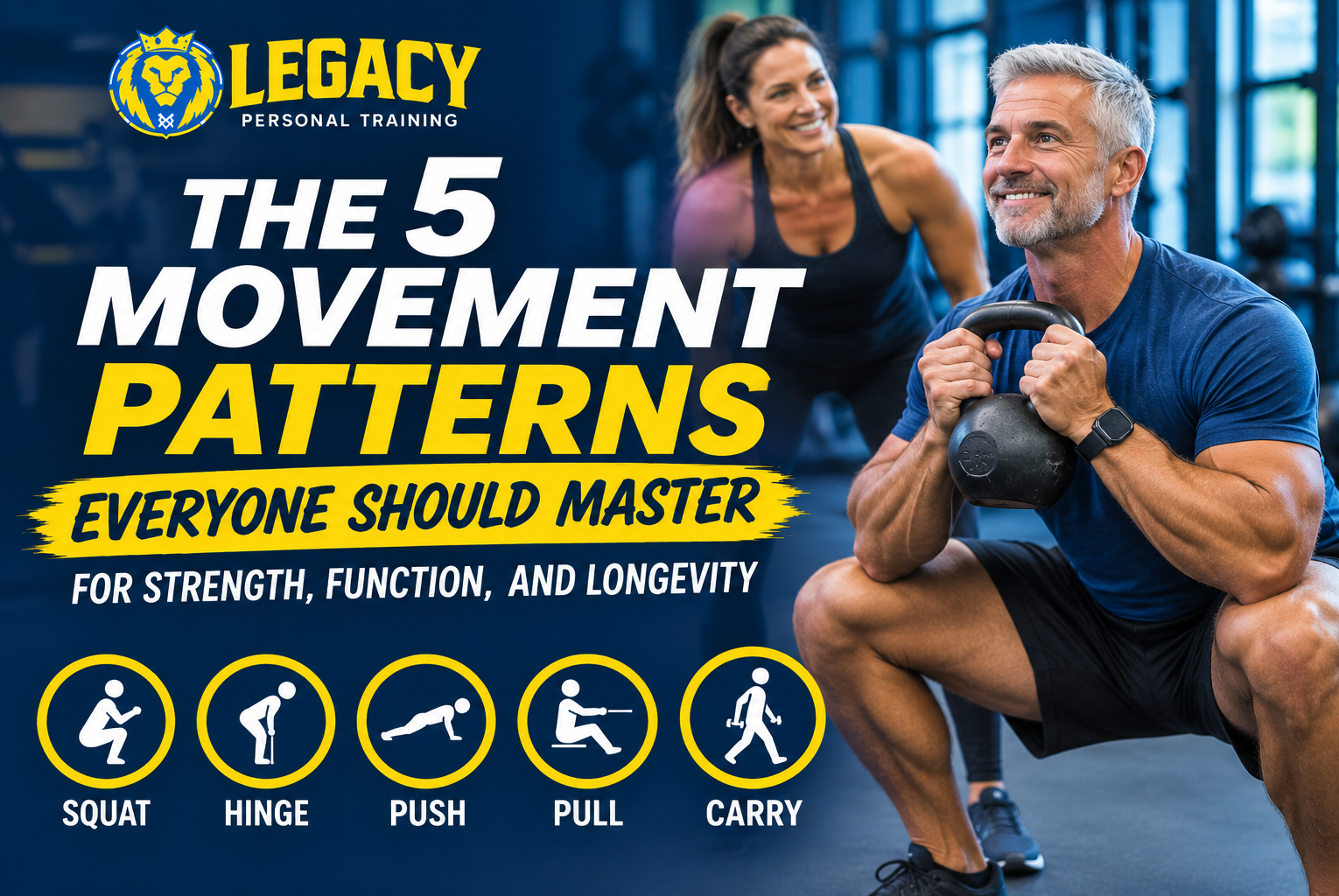
That’s where five fundamental movement patterns come in: squat, hinge, push, pull, and carry.
Developing these patterns can help create a foundation for strength, mobility, stability, coordination, and long term physical independence. The specific exercises you use might change based on your ability, experience, injury history, and goals, but the movement patterns themselves stay incredibly important.
Why Movement Patterns Matter More Than Individual Exercises
There isn’t one exercise that everyone has to perform exactly the same way.
One person might perform a traditional squat while someone else starts by sitting down to a box or bench. One person might deadlift a barbell while another learns a hip hinge with a kettlebell. Someone might perform a pushup from the floor while another starts with an elevated version.
The exercise is simply the tool.
The movement pattern is what we’re trying to develop.
That’s an important distinction because strength training should meet you where you are today while helping you gradually increase what your body can do.
If you’re brand new to strength training, you shouldn’t be expected to perform the same exercise variation as someone who’s been consistently training for years.
What matters is developing confidence and strength within the underlying movement.
And these five patterns show up constantly both inside and outside the gym.
1. The Squat: Your Foundation for Sitting and Standing
The squat might be one of the most recognizable strength exercises, but you’ve probably been squatting for most of your life without thinking about it.
Every time you sit down and stand back up, you’re using a version of a squat.
A squat involves coordinated movement through your hips, knees, and ankles while your lower body produces force. Your quadriceps, glutes, hamstrings, calves, and trunk all contribute to the movement.
That makes the squat much more than an exercise for your legs.
It’s a fundamental movement for everyday independence.
Think about getting out of a chair, standing up from the couch, lowering yourself toward the ground, or picking something up from a lower position. All of these tasks require some combination of lower body strength, mobility, balance, and control.
As you get older, maintaining that ability becomes increasingly valuable.
Why Can Squatting Become More Difficult?
Sometimes people assume that if squatting feels uncomfortable or awkward, they simply have “bad knees.”
It’s usually more complicated than that.
Ankle mobility, hip mobility, strength, balance, coordination, previous injuries, and movement habits can all influence how someone squats. Limited ankle mobility, for example, can change the way your entire squat looks and feels.
That’s why forcing everyone into the exact same squat usually isn’t the best approach.
If your heels lift from the floor, your knees move in a way you can’t control, or you can’t comfortably reach a certain depth, the answer might be to assess the movement and modify the exercise rather than simply telling you to try harder.
The goal is to develop the pattern safely and progressively.
2. The Hip Hinge: Learning How to Use Your Hips
The hip hinge is one of the most valuable movements to learn, but it’s also one that can feel a little strange at first.
A squat and a hinge might look somewhat similar, but they’re different patterns.
During a hinge, your hips move backward while your torso stays controlled. Instead of primarily lowering your body vertically like you would during a squat, you’re learning to move through your hips while maintaining stability through your trunk.
Deadlift variations, Romanian deadlifts, hip thrusts, and kettlebell swings are all examples of exercises that use the hinge pattern.
Why does that matter outside the gym?
Think about picking up a laundry basket, lifting something from the ground, moving furniture, or reaching down to grab something.
You need to know how to use your hips while controlling your torso.
The Hinge Helps Develop the Back Side of Your Body
The hinge is especially useful for developing what coaches often call the posterior chain, which includes many of the muscles along the back side of your body.
Your glutes and hamstrings play major roles, along with the muscles responsible for maintaining stability through your trunk.
Learning to hinge well can also help you understand the difference between moving through your hips and simply rounding through your back.
That doesn’t mean your spine has to remain perfectly motionless during everything you do. Your body is designed to move. But when you’re lifting something challenging, having the strength and awareness to control your torso while producing force through your hips can be extremely useful.
Once you learn what a good hinge feels like, it often starts becoming much more natural in everyday life.
3. The Push: Building Strength for Everyday Life
Pushing is another movement we perform constantly.
Inside the gym, pushing exercises might include pushups, chest presses, shoulder presses, and other pressing variations.
Outside the gym, you might push open a heavy door, move furniture, push yourself away from the floor, or place something overhead.
The exact direction might change, but the basic concept stays the same. You’re producing force away from your body.
Upper body pushing exercises typically involve your chest, shoulders, triceps, and the muscles responsible for stabilizing your trunk and shoulders.
And this is where functional strength starts making a lot more sense.
Everyday objects don’t come with neatly labeled weights.
A heavy door doesn’t care what you can bench press. Your suitcase doesn’t care what dumbbells you use at the gym. Life simply presents physical tasks, and your body needs enough capacity to handle them.
That’s the bigger purpose behind building pushing strength.
4. The Pull: Strengthening Your Back and Supporting Better Movement
If pushing moves resistance away from you, pulling generally brings resistance toward you.
Rows, pulldowns, and many biceps exercises fall into this category.
Pulling movements help strengthen muscles throughout your back, shoulders, and arms. They can also play an important role in developing control around your shoulder blades and supporting healthy movement through the upper body.
Pushing and pulling should also work together within a well designed strength program.
You shouldn’t just walk into the gym and randomly choose exercises because they look interesting. Good programming considers how different movements complement each other, how much work you’re doing, and whether your overall program is balanced.
That’s one of the reasons personalized coaching can be so valuable. A training program might look like a collection of exercises on the surface, but there should be a reason behind what you’re doing.
More Weight Doesn’t Always Mean More Progress
One common mistake with pulling exercises is using so much weight that momentum takes over.
You’ve probably seen it before.
Someone is performing a row or pulldown, but instead of controlling the resistance with the muscles they’re trying to train, their entire torso starts swinging.
At that point, the question becomes whether you’re actually controlling the weight or simply finding a way to move it from point A to point B.
There’s a big difference.
Sometimes dropping the weight and using a better range of motion with more control can give you a much more productive training stimulus.
The number printed on the dumbbell isn’t the goal.
Becoming stronger is.
5. The Carry: One of the Most Practical Strength Exercises You Can Do
The final movement is almost comically simple.
Pick something up and carry it.
But simple doesn’t mean easy.
Loaded carries can challenge your grip, trunk stability, posture, coordination, balance, and total body strength at the same time.
Farmer carries, suitcase carries, overhead carries, and other variations can all be used depending on your current abilities.
And the connection to everyday life couldn’t be more obvious.
Think about carrying groceries from the car, hauling luggage through an airport, moving boxes, picking up awkward objects around the house, or carrying something on one side of your body while trying to stay balanced.
These are real world strength demands.
Why Grip Strength Matters
You can have strong legs and a strong back, but if you can’t maintain your grip on something, your ability to carry it is limited.
Grip strength improves the same way other forms of strength improve. You progressively challenge it.
That might mean carrying weights, holding challenging objects, or gradually increasing the amount of time you can hang from a bar.
If you can only hang for eight seconds today, that’s okay.
That’s your starting point.
Maybe you work toward 10 seconds. Then 12. Then 15.
This principle applies to almost everything in strength training.
Find out what you can do today, then gradually build from there.
What If You Can’t Perform All Five Movement Patterns Well?
This is where a lot of people get intimidated by strength training.
They assume they need to already be fit enough to start.
You don’t.
If you can’t comfortably squat today, that doesn’t mean you should avoid training.
If your balance makes carrying weights challenging, that doesn’t mean loaded carries are permanently off limits.
If you can’t perform a pushup from the floor, you don’t need to force yourself through bad repetitions just to say you did one.
There are progressions and modifications for all of these movement patterns.
The goal is to find the appropriate starting point.
At Legacy Personal Training, that’s one reason we assess movement instead of simply handing everyone the same generic workout. Through our Body Mapping System, we can better understand how someone currently moves and use that information to personalize their training.
Your exercises should fit your current ability while creating opportunities to improve it.
Why These Five Movements Become Even More Important as You Age
The purpose of strength training starts to look different when you think beyond the next few months.
At 25, someone might walk into the gym primarily because they want bigger arms or more defined abs.
There’s nothing wrong with that.
But as you move through your 40s, 50s, 60s, and beyond, physical capability becomes a much bigger part of the conversation.
Can you get out of a chair easily?
Can you pick up something heavy without worrying about hurting yourself?
Can you carry your luggage?
Can you move furniture?
Can you put something onto an overhead shelf?
Can you carry groceries without losing your balance?
Can you get through a physically demanding day without feeling like every task is pushing you to your limit?
These aren’t bodybuilding questions.
They’re quality of life questions.
Strength training gives you an opportunity to build more physical capacity than everyday life requires.
That extra capacity matters.
If standing up from a chair requires only a small percentage of your lower body strength, it feels easy. If carrying a suitcase requires only a fraction of your carrying capacity, travel becomes easier.
The goal isn’t simply to become good at exercises.
It’s to make life easier to handle.
You Don’t Need to Master the Most Advanced Version
When we talk about mastering these movements, that doesn’t mean performing the most advanced version possible.
You don’t have to squat hundreds of pounds to have a strong, useful squat pattern.
You don’t need an enormous deadlift to benefit from learning how to hinge.
You don’t need to perform dozens of floor pushups before pushing strength becomes useful.
And you definitely don’t need to carry the heaviest dumbbells in the gym.
Mastery means developing enough strength, control, coordination, and confidence to perform the pattern appropriately for your body and your goals.
Then you keep progressing.
That’s what sustainable strength training looks like.
Strength Training Should Make Your Life Outside the Gym Better
This is ultimately the most important reason to train these five movement patterns.
The gym is practice. Life is where you use what you’ve built.
At Legacy Personal Training, we want our members to become stronger in the gym, but the reason for increasing weights and improving movement quality isn’t simply to put better numbers on a workout screen.
We want that progress to transfer into everyday life.
You squat so sitting and standing stay easy.
You hinge so you can confidently pick things up.
You push and pull so your upper body stays strong and capable.
You carry so your grip, trunk, posture, and total body strength can handle the physical demands life puts in front of you.
That’s functional strength.
And it becomes increasingly valuable with every decade.
Ready to Find Your Starting Point?
If you’re not sure how well you move, what exercises are appropriate for you, or where to begin with strength training, you don’t have to figure it out on your own.
At Legacy Personal Training in Scottsdale, Arizona, our approach starts by understanding you as an individual. Our L.I.F.T. approach, Lifestyle Integrated Fitness Training, combines movement assessment, personalized programming, structured training, progress tracking, and ongoing coaching to help fitness fit into your life.
Whether you’re completely new to strength training, returning after years away, or looking for a smarter way to train as you get older, the first step is figuring out where you are today.
Book a Starting Point Consultation at Legacy Personal Training in Scottsdale.
We’ll talk about your goals, training history, current abilities, and what you want to continue doing in the years ahead. From there, we can help you build a plan around you.
You don’t need to be great at all five movement patterns before you start.
You start so you can get better at them.