
Understanding the Changing Perception of Age in Modern Society
In the ever-accelerating rhythm of contemporary life, the way we perceive age has undergone a profound transformation. Gone are the days when turning 50 was seen as entering a period of comfortable maturity or gentle transition. Instead, many today feel that 50 has become synonymous with what 70 once represented, a stage marked by fatigue, heightened stress, and a sense of being left behind in a relentlessly moving world. This shift in mindset isn’t merely a product of nostalgia or generational comparison; it’s rooted in the tangible demands and expectations that modern society places on individuals as they navigate midlife.
There was a time when turning 70 was commonly associated with slowing down. Less activity, less strength, more physical limitations, and fewer expectations for what your body should be able to do.
That picture of aging is changing.
Today, more adults are asking a different question: What can I do now to stay strong, active, and independent as I get older?
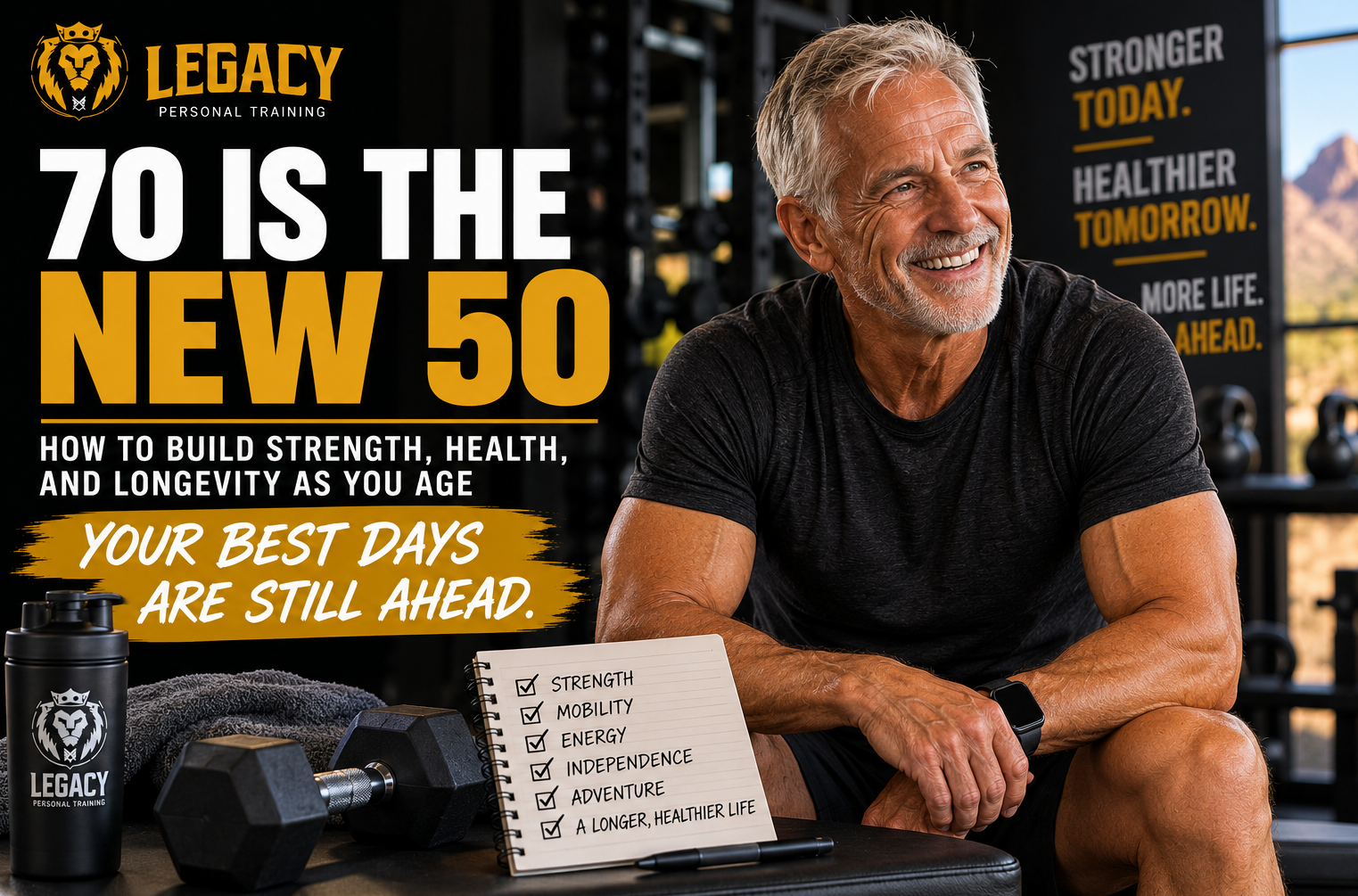
That’s really what the idea of “70 is the new 50” is about. It’s not about pretending aging does not happen or expecting your body to perform exactly as it did decades ago. It is about recognizing that the choices you make in your 40s, 50s, and 60s can have a meaningful impact on how you experience your 70s and beyond.
At Legacy Personal Training in Scottsdale, we see this firsthand. Many of the adults we coach are not training because they want to look like they did at 25. They are training because they want to continue traveling, golfing, hiking, working, playing with their grandchildren, getting up and down from the floor, carrying their own luggage, and living independently for as long as possible.
Healthy aging is not about trying to stop the clock. It is about building a body that is prepared for what comes next.
Healthy Aging Starts Earlier Than Most People Think
One of the biggest misconceptions about longevity is that it is something you start worrying about when you become “old.” In reality, some of the most important years for building your future physical capacity may be the decades before that.
Your 40s and 50s can be an important time to take inventory of your health. Maybe your body composition has started changing. Perhaps maintaining your weight is more difficult than it used to be. You might notice that you do not recover as quickly, feel as strong, or move as easily as you once did.
It can be tempting to dismiss those changes as simply getting older. But getting older does not mean you have to stop getting stronger.
The strength, muscle, mobility, balance, cardiovascular fitness, and healthy habits you build today can become part of the physical reserve you carry into the decades ahead. Instead of waiting until you have lost significant strength or mobility to do something about it, you can begin building capacity now.
Being Thin Is Not the Same as Being Fit
Another misconception we often encounter is the idea that if your body weight has not changed much, your health and fitness must be fine.
The scale does not tell the entire story.
Someone can maintain a relatively low body weight while still lacking muscle, strength, cardiovascular fitness, mobility, or endurance. This becomes increasingly important as we age because maintaining muscle is about much more than appearance.
Muscle helps you produce force, maintain balance, climb stairs, carry groceries, get out of a chair, participate in recreational activities, and handle many of the physical demands of everyday life.
That is why the conversation after 40 should not only be about losing weight.
It should also be about what you are building and preserving.
If weight loss comes at the expense of muscle and strength, seeing a smaller number on the scale may not represent the kind of progress you actually want for long term health.
Why Strength Training Matters More as You Get Older
Strength training is one of the most valuable tools adults can use to maintain physical capacity as they age.
That does not mean everyone needs to lift extremely heavy weights or train like a competitive athlete. Effective strength training should be appropriate for your current ability, training experience, movement quality, injury history, and goals.
For adults over 40, the purpose is bigger than completing a difficult workout. The goal is to create a progressive training stimulus that helps your body remain strong and capable.
At Legacy Personal Training, this is why we emphasize personalized programming rather than putting everyone through exactly the same workout. Two people can both be 60 years old and have completely different bodies, backgrounds, limitations, and goals.
One person may need to spend more time developing stability and movement quality. Another may be ready to focus heavily on strength and muscle. Someone else may need a combination of strength, balance, mobility, and power.
Your age matters, but it should not be the only thing determining how you train.
Consistency Matters More Than the Perfect Workout
People often become highly motivated when they decide it is time to get healthy. They want to train every day, completely overhaul their nutrition, eliminate everything they consider unhealthy, and see results immediately.
The problem is that an extreme plan can be difficult to sustain.
If your goal is longevity, you have to think beyond what you can accomplish over the next 30 days. You need habits that can become part of your life for years.
That is why consistency matters so much.
Three or four appropriate workouts completed consistently can accomplish far more than repeatedly cycling between extreme effort and long periods of doing nothing.
You do not need every workout to be your hardest workout. You need to keep showing up.
Over time, those individual workouts accumulate. Strength improves. Movement improves. Your confidence grows. Training becomes part of your schedule instead of something you are constantly trying to restart.
This is also where coaching and accountability can make a significant difference. When your workouts are planned, your coaches know your goals, and someone is expecting you to show up, fitness becomes much easier to integrate into your normal life.
Healthy Aging Is About More Than Exercise
Strength training is important, but you cannot separate training from the rest of your lifestyle.
Nutrition, sleep, recovery, stress management, alcohol consumption, daily activity, and your overall health habits all contribute to the bigger picture.
Nutrition is a particularly important part of the longevity conversation. As we get older, the goal should not simply be eating as little as possible to keep our weight down. We want nutrition that supports our activity, recovery, muscle, and body composition goals.
Protein becomes especially relevant for adults focused on maintaining and building muscle. So does eating in a way that is realistic enough to maintain over time.
You do not have to eat perfectly to age well. In fact, trying to be perfect can sometimes make consistency harder. A sustainable approach allows room for real life while keeping the majority of your choices aligned with the person you are trying to become.
The same principle applies to recovery. More exercise is not automatically better. Your body needs time and resources to adapt to training. Sleep, rest, appropriate training volume, and stress management all play a role in how well you recover and continue progressing.
Stop Waiting for Something to Go Wrong
One of the most important shifts you can make as you get older is moving from a reactive mindset to a proactive one.
Too often, people wait for a wake up call.
They wait until their doctor becomes concerned about their health. They wait until everyday activities become difficult. They wait until they lose significant strength or mobility. They wait until an upcoming event suddenly creates motivation to lose weight.
You cannot control every aspect of your health, and no lifestyle can guarantee that you will avoid illness or injury. But there are many things you can influence.
You can strength train. You can stay active. You can improve your nutrition. You can prioritize recovery. You can work on your balance and mobility. You can monitor changes in your body composition. You can work with qualified healthcare professionals when appropriate.
You do not need to wait until something is wrong before deciding that your health deserves attention.
Motivation Will Come and Go
Another reason people struggle with long term fitness is that they rely too heavily on motivation.
Motivation feels great when it is there. The problem is that it eventually fades.
There will be mornings when you do not feel like exercising. There will be busy weeks. There will be vacations, work deadlines, family commitments, and countless other things competing for your attention.
Long term consistency requires something more dependable than motivation.
It requires structure.
Having specific days you train, knowing what you are going to do when you arrive, having coaches who know your goals, and making fitness part of your weekly routine removes many of the decisions that cause people to fall off track.
Eventually, training can stop feeling like another temporary health project and start becoming something you simply do.
That is where lasting change begins.
What Should You Focus on to Age Well?
There is no single workout or nutrition plan that guarantees healthy aging, but there are several areas worth prioritizing.
Build and maintain strength. Do not wait until you feel weak to decide strength matters. Resistance training can help you continue developing and maintaining the physical capacity needed for everyday life.
Protect your muscle. Muscle is not just about appearance. Maintaining muscle supports strength, movement, balance, body composition, and your ability to remain physically active.
Keep moving outside the gym. Your workouts are important, but so is the rest of your week. Walking, hiking, golfing, traveling, recreational activities, and simply staying engaged with life all matter.
Make nutrition sustainable. Instead of constantly searching for the next diet, work toward eating habits that support your goals and can realistically fit your lifestyle.
Prioritize recovery. Sleep, stress management, rest, and appropriate training volume become increasingly important when the goal is to continue training for decades.
Measure more than your weight. The scale is only one piece of information. Strength, body composition, energy, movement quality, consistency, and physical capability can provide a much broader view of progress.
Is It Too Late to Start Strength Training at 50, 60, or 70?
One of the most common questions adults ask is whether they waited too long.
Maybe you have not exercised consistently in years. Maybe you have never strength trained before. Perhaps an old injury made you hesitant to return to a gym. Or maybe you simply spent the last few decades prioritizing your career and family and realized that your own health kept getting pushed down the list.
Your starting point matters because your training should meet you where you are. But your starting point does not have to become your permanent destination.
You do not need to compare yourself to someone else your age. You also do not need to train like you did when you were 25.
The better question is: What can I start doing now that could improve the way I live five, ten, or twenty years from today?
For one person, that might mean starting with basic strength and stability work. For another, it could mean returning to consistent resistance training after years away. Someone else may already exercise regularly but need a more personalized approach to continue progressing safely.
Wherever you are starting, the objective is the same: build from where you are today.
Don’t Train to Be Younger. Train to Live Better Longer.
Healthy aging should not be about chasing your younger self.
You are not training to go backward.
You are training for what is ahead.
You are training so you can carry your own suitcase when you travel. You are training so you can keep playing golf, hiking Scottsdale trails, getting down on the floor with your grandchildren, and saying yes to experiences without wondering whether your body can handle them.
You are training so that strength remains an asset as you get older instead of something you wish you had protected earlier.
That is what “70 is the new 50” should really mean.
It is not a promise that aging disappears. It is a reminder that aging does not have to mean giving up on strength, progress, goals, or an active life.
Your best days do not automatically have to be behind you.
There is still plenty to build.
Build Strength for the Years Ahead at Legacy Personal Training in Scottsdale
At Legacy Personal Training in Scottsdale, Arizona, we help adults build strength, maintain muscle, improve body composition, move better, and create sustainable fitness habits that support the way they want to live.
Our L.I.F.T. approach, Lifestyle Integrated Fitness Training, is designed around the idea that fitness should integrate into your life rather than take it over. Training is personalized to your body, abilities, and goals so you can continue making progress without feeling like you have to train like someone else.
Whether you are 40 and starting to think more seriously about longevity, 50 and realizing it is time to make your health a priority, or 70 and determined to keep moving forward, what matters most is what you choose to build from here.
Because the goal is not simply to live longer. It is to build the strength and capacity to keep living well.