
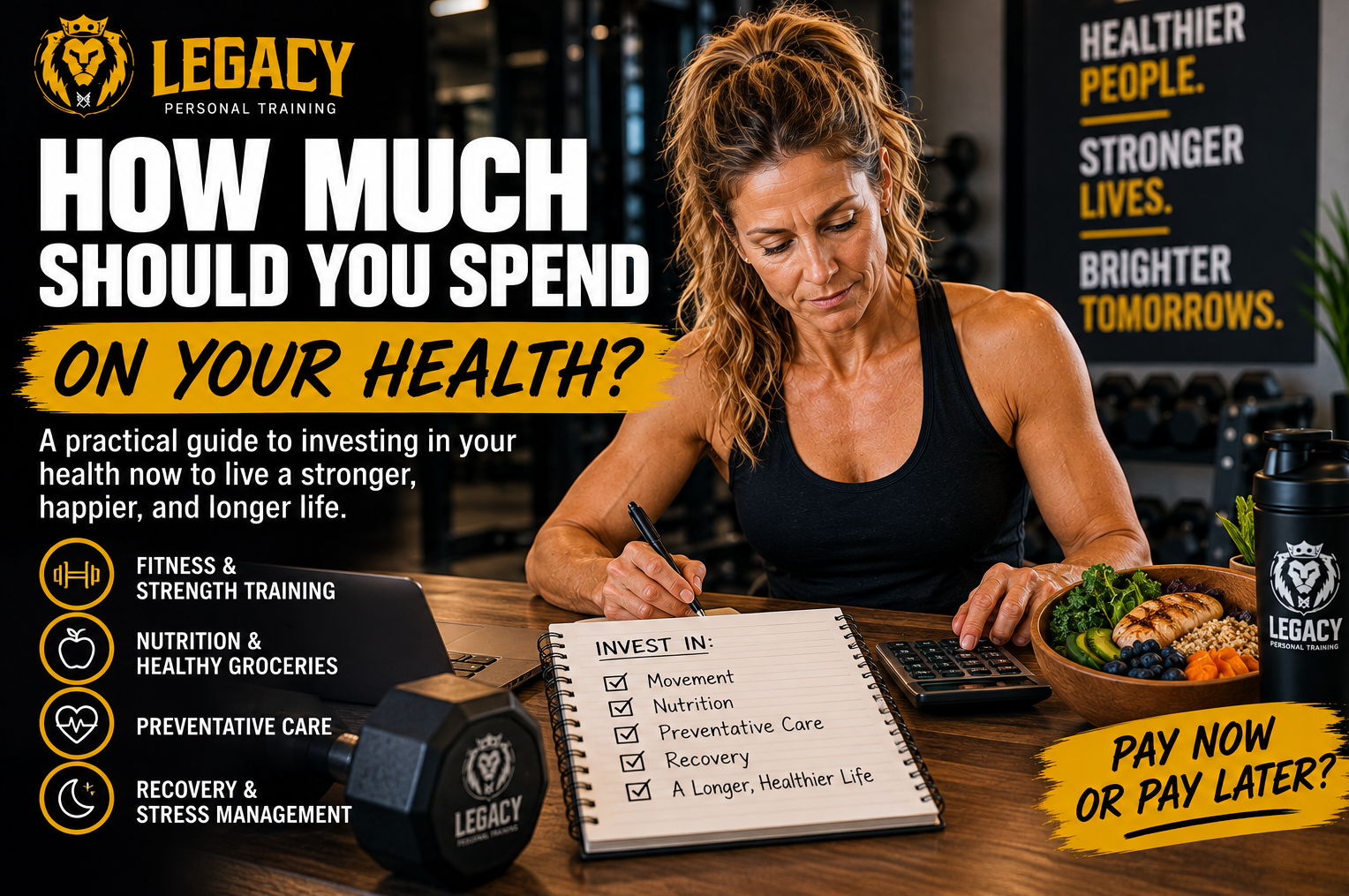
Why Investing in Your Health Now Matters More Than Ever
We budget for almost everything in life. Our mortgage, car payments, groceries, vacations, entertainment, retirement, and even the occasional purchase we probably don’t need. We carefully consider where our money goes and what we believe is worth spending it on.
But here’s a question most people rarely stop to ask: How much of your monthly budget are you intentionally investing in your health?
Not just health insurance. Not just doctor visits or prescription medications. We’re talking about the things you do consistently to keep yourself healthy, strong, active, and capable of enjoying your life.
For many people, health becomes a financial priority only after something goes wrong. We might hesitate to spend money on a gym membership, personal training, or healthier groceries, but when a medical issue arises, those expenses suddenly seem small compared to the cost of managing a health condition.
It’s worth asking ourselves a difficult question: Are we willing to invest in our health now, or are we waiting until our health demands our attention later?
At Legacy Personal Training in Scottsdale, we believe fitness should be viewed as a long term investment in your quality of life, not simply another monthly expense. And when you start thinking about health from that perspective, the way you prioritize your time and money can begin to change.
What Percentage of Your Budget Should Go Toward Your Health?
There is no universally recommended percentage of income that everyone should spend on their health. Your financial situation, insurance coverage, medical needs, family responsibilities, and personal goals all influence what makes sense.
However, a useful starting point is to consider setting aside 5% to 10% of your take home income for proactive health and wellness expenses, provided your essential expenses, medical needs, and financial obligations are covered.
This is not an official healthcare recommendation or a rule that everyone should follow. It is simply a practical budgeting framework that can help you begin treating your health as a recurring priority rather than something you only spend money on when necessary.
For example, someone bringing home $6,000 per month might consider allocating $300 to $600 toward activities and services that support their long term health. That money could go toward strength training, fitness coaching, nutritious groceries beyond their normal food budget, recovery services, or other appropriate wellness expenses.
Someone with a smaller budget may need to start with significantly less. That’s completely reasonable. The important thing is not reaching an arbitrary dollar amount. It’s being intentional about making room for your health within your financial circumstances.
And before you decide what that budget should look like, it’s important to understand what actually qualifies as an investment in your health.
What Should Count as a Health Expense?
When most people think about healthcare spending, they immediately think about insurance premiums, copays, prescriptions, and doctor appointments.
Those are important expenses, but they represent only part of the picture.
Your health budget should also account for the daily habits, services, and resources that help you maintain your physical and mental well-being.
1. Strength Training and Physical Activity
Exercise is one of the most valuable investments you can make in your long term health. Regular physical activity supports cardiovascular health, muscle strength, bone health, metabolic function, mobility, and mental well-being.
The Physical Activity Guidelines for Americans recommend that adults get at least 150 minutes of moderate aerobic activity each week, along with strength training activities on at least two days.
But knowing that exercise is important and actually maintaining a consistent routine are two different things.
This is where a gym membership, personal training, or structured fitness program can become a valuable investment. You’re not simply paying for access to equipment. Depending on the program, you’re paying for professional guidance, accountability, personalized programming, and an environment that helps you stay consistent.
At Legacy Personal Training, we often work with adults who have spent years trying to exercise on their own. They know they should be doing something, but they struggle to maintain a routine or aren’t sure what exercises are appropriate for their body.
For those individuals, investing in coaching can help turn exercise from something they repeatedly start and stop into a sustainable part of their lifestyle.
2. Quality Nutrition and Healthy Groceries
Your grocery bill is already part of your monthly budget, but have you considered how much of that spending supports your health?
Nutritious food doesn’t have to be expensive, and eating well doesn’t require shopping exclusively at specialty grocery stores or buying organic versions of everything.
However, prioritizing quality protein sources, fruits, vegetables, whole grains, and other nutrient dense foods can make a meaningful difference in how you feel, recover, and maintain your body composition.
For adults over 40, adequate protein becomes particularly important because maintaining muscle is a major component of healthy aging.
Instead of viewing healthier groceries as an unnecessary upgrade, consider them part of the foundation supporting your strength, energy, and long term health.
It’s also worth looking at the money spent on convenience purchases that don’t necessarily support your goals. Frequent restaurant meals, alcohol, snacks, and specialty drinks can add up quickly. Sometimes improving your nutrition budget isn’t about spending more money. It’s about redirecting money you’re already spending.
3. Preventative Healthcare
Routine medical care is another important part of investing in your health.
Depending on your age, medical history, and individual risk factors, that may include annual wellness visits, recommended screenings, dental care, appropriate blood work, and conversations with your healthcare providers about changes in your health.
Preventative care doesn’t guarantee you will avoid illness, but it can help identify certain problems earlier and provide opportunities to manage risk factors.
Your health budget should make room for appropriate medical care rather than treating it as something to address only when symptoms appear.
4. Recovery, Sleep, and Stress Management
Health isn’t just about what happens during your workout.
Recovery, sleep, and stress management also influence your ability to feel good, perform well, and maintain healthy habits.
Depending on your individual needs, investing in recovery might mean working with a qualified professional to address mobility limitations, seeking appropriate care for persistent pain, improving your sleep environment, or getting support for mental health.
Not every recovery strategy requires spending money. Sometimes the most valuable changes are free, such as maintaining a consistent bedtime, taking walks, or setting boundaries around work.
The goal is to recognize that recovery deserves attention, even when it doesn’t come with a monthly membership fee.
The Real Cost of Poor Health: Pay Now or Pay Later?
There’s a common idea that you can either invest in your health today or potentially pay a much higher price for poor health later.
There is truth behind that idea, although it’s important to understand that not every illness is preventable. Genetics, environmental factors, accidents, and circumstances outside our control all influence health outcomes. People can make excellent lifestyle choices and still develop serious medical conditions.
But we also know that many common chronic conditions are influenced by modifiable risk factors, including physical inactivity, poor nutrition, smoking, and excessive alcohol consumption.
According to the Centers for Disease Control and Prevention, approximately 90% of the nation’s $5.3 trillion in annual healthcare expenditures are for people with chronic and mental health conditions. The CDC also estimates that inadequate physical activity is associated with approximately $192 billion in annual healthcare costs. CDC
Those numbers are substantial, but they also point to something important: the decisions we make about our health have consequences that extend beyond the gym.
When health declines, the financial impact may include medical appointments, medications, treatment costs, lost productivity, and time away from work. For some people, it can also mean giving up activities they enjoy or needing additional assistance with everyday tasks.
The cost isn’t always measured in dollars.
Sometimes it’s measured in independence, energy, confidence, or the ability to participate in your own life.
Why Investing in Your Health Becomes More Important After 40
Your 40s, 50s, and 60s are particularly important decades for thinking about the relationship between health and money.
For many adults, these are also their peak earning years. Careers are demanding, family responsibilities are significant, and retirement planning becomes increasingly important.
It’s easy to justify putting health on the back burner because there are so many other priorities competing for your time and resources.
But consider what you’re working toward.
Maybe you’re saving for retirement so you can travel. Maybe you’re building a business that will eventually give you more freedom. Perhaps you’re working hard to provide experiences for your family or create financial security for your future.
Now imagine reaching those milestones without the physical capacity to enjoy them.
What good is the retirement you’ve spent decades saving for if you struggle to walk through an airport, explore a new city, or participate in the activities you’ve been looking forward to?
Financial security matters. But so does having the strength, mobility, and health to enjoy the life you’ve worked to build.
Your retirement plan should include more than your financial future. It should also include your physical future.
Is Personal Training Worth the Money?
This is a reasonable question, especially when you’re comparing the cost of personal training with a traditional gym membership.
A basic gym membership may provide access to equipment at a relatively low monthly cost. For someone who already understands exercise programming, trains consistently, and knows how to adjust their workouts, that may be exactly what they need.
But for many adults, particularly those over 40, access to equipment isn’t the biggest challenge.
The challenge is knowing what to do, how to do it correctly, how hard to push, when to recover, and how to remain consistent when life gets busy.
That’s where professional coaching can provide additional value.
You’re Investing in a Plan, Not Just a Workout
A good personal training program should be designed around your individual needs.
Someone returning to exercise after ten years should not necessarily be following the same program as someone who has been strength training consistently for a decade.
Your current strength, movement limitations, injury history, body composition goals, and lifestyle should all influence how your training is structured.
At Legacy Personal Training in Scottsdale, our approach begins with understanding the individual. We use movement assessments, personalized programming, and ongoing progress tracking to help members train appropriately for their goals.
Our L.I.F.T. approach, Lifestyle Integrated Fitness Training, emphasizes movement quality, progressive strength development, and sustainable consistency.
The goal isn’t simply to make you tired during a workout. It’s to help you make progress that carries over into your everyday life.
Accountability Has Value
Many people underestimate how valuable accountability can be.
Consider how many gym memberships are purchased with good intentions but rarely used. The membership itself may be inexpensive, but if you’re not showing up, you’re not getting much value from it.
Now compare that with a coaching program where you train consistently, follow a structured plan, and have professionals helping you stay on track.
The more expensive option may provide greater value if it helps you establish habits you otherwise struggle to maintain.
Of course, no coaching program can guarantee results, and the right choice depends on your goals and budget. But when evaluating the cost of personal training, it’s worth considering what you’re actually receiving rather than looking only at the monthly price.
We Spend Money on What We Value. Does Your Budget Reflect Your Priorities?
Here’s an exercise worth trying.
Look at your bank statement from the past month.
How much did you spend on restaurants, entertainment, subscriptions, shopping, convenience purchases, and other discretionary expenses?
Now compare that with how much you spent intentionally supporting your health.
This isn’t about feeling guilty for enjoying your money. Life should be enjoyed, and there is nothing wrong with spending money on experiences, hobbies, or things that make you happy.
The question is whether your spending reflects what you say matters most.
Most people would rank their health among their highest priorities. But their budgets don’t always reflect that.
If you can comfortably spend several hundred dollars a month on dining out, entertainment, or shopping, but consistently tell yourself that investing in exercise or healthier food is too expensive, it may be worth reconsidering how you’re allocating your resources.
Sometimes we don’t need more money to prioritize our health.
We need to make different decisions about the money we already have.
How to Create a Realistic Monthly Health Budget
Building a health budget doesn’t have to be complicated, and it certainly shouldn’t create financial stress.
Start by identifying your essential expenses, including housing, utilities, transportation, food, insurance, medical care, debt obligations, and savings.
From there, look at your remaining discretionary income and determine what amount you can realistically dedicate to proactive health.
For some people, that might mean investing in a personalized strength training program. For others, it may mean beginning with a lower cost gym membership, preparing more meals at home, or making better use of free activities like walking and hiking.
The key is choosing investments that address your biggest needs.
If you already eat well but struggle to exercise consistently, coaching may be the most valuable place to direct your resources. If you’re active but frequently rely on takeout and struggle to get enough protein, improving your grocery habits may be a better starting point.
And if you have ongoing medical concerns, appropriate healthcare should take priority over optional wellness services.
You don’t need to spend money on every health trend, supplement, recovery device, or fitness program. You need to invest in the things that will make the greatest difference for your individual situation.
Your Health Is an Investment That Compounds Over Time
One of the most useful ways to think about health is to compare it with investing for retirement.
When you contribute money to a retirement account, you don’t expect to become wealthy overnight. You understand that consistent contributions over many years can create meaningful results.
Fitness works similarly.
One strength training session won’t transform your health. One healthy meal won’t change your body composition. One good night’s sleep won’t erase years of poor habits.
But those decisions accumulate.
Consistent resistance training can help you build and maintain muscle. Regular physical activity can improve cardiovascular fitness. Sustainable nutrition habits can support healthier body composition. Appropriate recovery allows you to continue training and progressing.
Over time, these habits can help build the physical capacity you want to carry into your later years.
The difference is that your health investment pays dividends you can experience along the way.
You may notice that you feel stronger, move more comfortably, have more energy, or feel more confident participating in activities you enjoy.
Those benefits matter today, not just twenty years from now.
What Is the Return on Investment for Your Health?
We often evaluate financial decisions by asking what kind of return we’ll receive.
When it comes to your health, the return is more difficult to measure because it isn’t always financial.
Yes, healthier habits may reduce the risk of certain chronic conditions and potentially help avoid some future healthcare expenses. But you cannot calculate exactly how much money a gym membership or nutrition program will save you over your lifetime.
What you can evaluate is how your investment affects your quality of life.
Are you getting stronger? Are you maintaining muscle as you age? Can you move more comfortably? Are you developing better habits? Do you have more energy for your family, career, and hobbies? Are you building the physical capacity to remain active and independent?
These are meaningful returns, even when they don’t show up on a bank statement.
For many adults, the ultimate goal isn’t simply to live longer. It’s to continue enjoying the years they have.
If You Don’t Have Your Health, What Do You Really Have?
You’ve probably heard the saying, “If you don’t have your health, you don’t have anything.”
It’s a powerful statement, and while life is more complicated than that, the underlying message is worth considering.
We can spend decades building careers, growing businesses, saving money, and creating the lives we want. But our ability to enjoy those accomplishments is closely connected to our physical and mental well-being.
That doesn’t mean everyone needs to be in perfect health. Perfect health isn’t a realistic standard, and many people live fulfilling, active lives while managing chronic conditions or disabilities.
It means that caring for your health deserves a place alongside your other important priorities.
Your health isn’t separate from your life.
It influences how you experience your life.
And while investing in your health today cannot guarantee that you will avoid medical expenses later, it can help you build strength, resilience, and healthier habits that support your future.
Invest in Your Future at Legacy Personal Training in Scottsdale
At Legacy Personal Training in Scottsdale, Arizona, we believe strength training is one of the most valuable investments adults can make in their long term health.
We work with people who want more than a temporary fitness program. They want to get stronger, maintain muscle, improve body composition, move better, and feel confident about their physical abilities as they age.
Our personalized approach combines structured strength training, movement assessments, progress tracking, and coaching accountability to help members develop habits that fit into their lives.
Whether you’re in your 40s and thinking about your future health, in your 50s and ready to make a change, or in your 60s and beyond and determined to stay active, we’re here to help you build a stronger foundation.
If you’ve been considering personal training but keep putting it off because of the cost, we encourage you to think about the bigger picture.
What is your health worth to you?
What would it mean to feel stronger, move better, and have more confidence in your body?
And what could those improvements mean for the next ten, twenty, or thirty years of your life?
You work hard to build your financial future. Make sure you’re investing in the health that will help you enjoy it.
Because at the end of the day, the goal isn’t simply to have more money or more years.
It’s to have the health, strength, and freedom to make the most of both.