
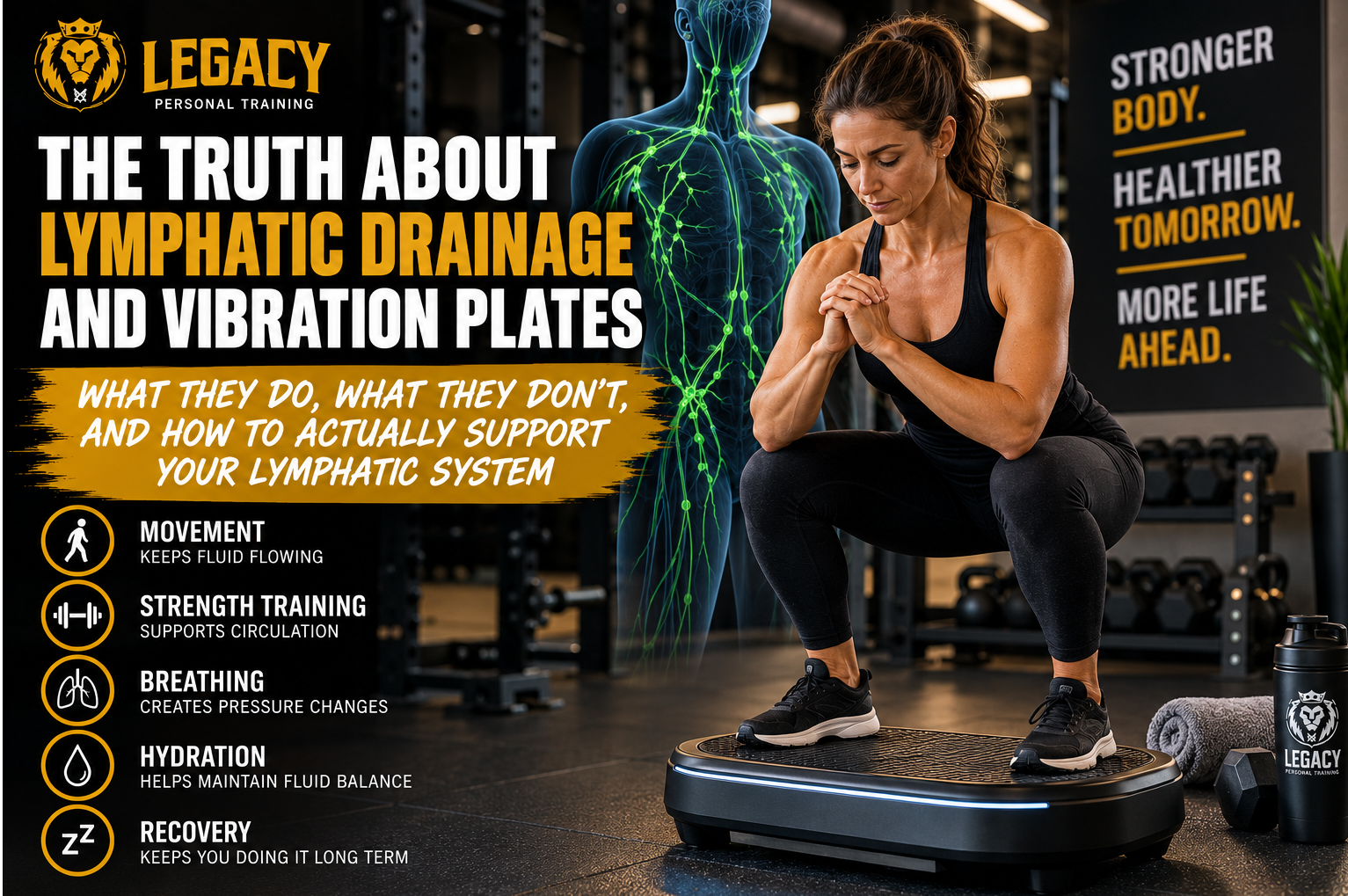
What Is the Lymphatic System and Why Does It Matter?
Vibration plates have become increasingly popular in the fitness and wellness world, especially among people interested in lymphatic drainage, recovery, cellulite reduction, and “detoxing.” Stand on a vibrating platform for a few minutes, let the machine do the work, and supposedly your lymphatic system gets a boost.
But what is actually happening?
The lymphatic system is an important part of the body, and movement does play a role in supporting normal lymph flow. That does not mean you need a vibration plate to keep your lymphatic system working properly, nor does it mean standing on one will detox your body, melt fat, or eliminate cellulite.
For most healthy, active adults, the fundamentals are much less exciting but far more useful: move regularly, strength train, breathe deeply, stay hydrated, recover well, and avoid spending most of your day sedentary.
At Legacy Personal Training in Scottsdale, we’re always interested in tools that can help people feel and perform better. But we also want our members to understand the difference between something that may be useful and something that is being marketed as a shortcut.
The lymphatic system helps maintain fluid balance in the body and transports lymph, a fluid containing substances such as proteins, immune cells, and cellular waste. Lymph moves through a network of vessels and lymph nodes before fluid is eventually returned to the bloodstream.
Most people are familiar with lymph nodes because they may notice them becoming swollen when they’re sick. Your lymph nodes are part of the body’s immune system and help filter lymph as it moves through the body.
There’s an important difference between your lymphatic and cardiovascular systems, however. Your cardiovascular system has the heart acting as a central pump. Your lymphatic system does not have an equivalent central pump continuously driving fluid through the system.
Instead, normal lymph movement is supported by mechanisms that include skeletal muscle contractions, body movement, and changes in pressure associated with breathing.
That’s one reason regular physical activity is so important.
How Does Exercise Support Lymphatic Drainage?
When people hear the term “lymphatic drainage,” they sometimes assume they need a special treatment or device to make it happen. In reality, your body is already designed to move lymph.
One of the simplest ways to support that process is to move.
When your muscles contract during walking, resistance training, and other physical activities, those contractions create pressure on surrounding tissues. That mechanical activity helps encourage lymph to move through lymphatic vessels.
This is another reason we encourage people to think beyond the hour they spend at the gym.
You could have a great strength training session in the morning, but if you spend nearly every remaining hour of the day sitting, your overall activity level may still be relatively low. Training matters, but so does walking, standing, taking the stairs, doing household activities, and simply moving throughout the day.
For adults over 40, this becomes part of the larger longevity conversation. Exercise is not only about how many calories you burn. Regular movement supports many normal physiological processes while helping you maintain strength and physical capacity.
Why Does Breathing Matter for Lymphatic Flow?
Movement isn’t the only mechanism involved. Breathing also creates pressure changes inside the body that can support lymph movement.
Deep diaphragmatic breathing involves using the diaphragm, the large muscle located beneath the lungs. Instead of taking shallow breaths primarily through the upper chest, diaphragmatic breathing creates more noticeable expansion around the abdomen and lower rib cage.
As pressure changes between the chest and abdominal regions, those changes can assist the movement of lymphatic fluid.
There is an additional benefit for people who strength train. Learning how to breathe and control pressure appropriately is also important for core stability and performing many resistance exercises effectively.
You do not need an elaborate breathing routine to support your lymphatic system. It is simply another reminder that the body is an interconnected system and that normal movement and breathing already provide mechanisms that help it function.
Do Vibration Plates Help With Lymphatic Drainage?
This is where the conversation gets more interesting.
A vibration plate is a platform that produces rapid mechanical vibrations while you stand, squat, or perform exercises on it. Those vibrations can cause small, rapid muscle contractions.
Because muscle contractions are one mechanism that helps support lymph movement, it is reasonable to understand why vibration plates have become associated with lymphatic drainage.
The important distinction is that the contractions produced by a vibration plate are not the same as intentionally moving your body through a full exercise program.
A vibration plate may provide some muscle stimulation and could be a useful supplemental tool for certain people. Some individuals also enjoy using one when they are sore because the movement and stimulation may feel good before another training session.
But if you are already walking regularly, strength training several times per week, and staying active throughout the day, you should not assume that you need a vibration plate to make your lymphatic system work.
Think of it as a possible addition, not a replacement for movement.
Can a Vibration Plate Replace Exercise?
No.
This is probably the most important takeaway if you are considering purchasing a vibration plate specifically for lymphatic drainage.
Standing on a vibrating surface while your muscles respond involuntarily is very different from deliberately producing force during resistance training, walking, climbing stairs, carrying objects, or performing other forms of physical activity.
Strength training asks your body to adapt. You are progressively challenging muscles to produce force and become stronger. Depending on the program, you are also training stability, coordination, balance, and other physical qualities.
A vibration plate cannot reproduce all of those benefits simply because it causes muscle activity.
There may be ways to combine the two. For example, some people perform squats, holds, or other movements while standing on a vibration platform. But the important part is still the same: the vibration plate should supplement movement rather than become an excuse to avoid it.
Do Vibration Plates Detox Your Body?
“Detox” is one of the most common words used in wellness marketing, and it can create a lot of confusion.
Your lymphatic system is involved in fluid movement and immune function, but that does not mean a vibration plate is “flushing toxins” out of your body.
Your body already has organs responsible for processing and eliminating waste, particularly the liver and kidneys. You do not need to shake toxins loose with a machine.
That does not make lymphatic health unimportant. It simply means we should describe what is happening accurately.
Instead of saying a vibration plate detoxifies the body, a more realistic way to think about it is that the vibrations create muscle activity and movement that may support circulation and lymph movement.
That may not sound as exciting as a dramatic detox claim, but it is a much more useful way to understand the tool.
Can Vibration Plates Get Rid of Cellulite?
Another common claim surrounding vibration plates and lymphatic drainage is that they can eliminate cellulite.
Cellulite is more complicated than excess fluid sitting underneath the skin. Its appearance can be influenced by factors including connective tissue structure, genetics, hormones, body fat distribution, and characteristics of the skin itself.
Changes in fluid distribution may temporarily affect the appearance of certain areas, but that does not mean a vibration plate is removing cellulite.
This is an important distinction because people can spend significant amounts of money chasing solutions to something that is a normal and very common feature of the human body.
If improving body composition is your goal, focus on the bigger picture. Consistent strength training, appropriate nutrition, adequate protein, regular activity, recovery, and sustainable habits are much more important than relying on a device that promises a shortcut.
What About Lymphatic Drainage Massage?
Manual lymphatic drainage is another option that has become increasingly popular. This is typically a much lighter and more specialized technique than the deep tissue massage many people are familiar with.
The goal is to encourage the movement of lymphatic fluid rather than aggressively working deep into the muscles.
Some people may find these treatments useful or enjoyable. As with vibration plates, however, it is helpful to think about them as supplemental rather than as substitutes for regular activity.
For healthy adults, you still want your body doing the work it is designed to do. Walking, exercising, breathing, and changing positions throughout the day provide regular opportunities for muscle contractions and pressure changes that support normal lymph movement.
What Is the Best Way to Support Your Lymphatic System Naturally?
You probably do not need a complicated lymphatic routine.
Start with movement. Walk regularly and avoid sitting for excessively long periods without getting up. Strength train consistently so your muscles are contracting, producing force, and being challenged through different movement patterns. Practice good breathing mechanics, particularly during exercise. Stay appropriately hydrated to support normal fluid balance.
Recovery matters too. If you train hard but never give your body enough opportunity to recover, maintaining consistency becomes much more difficult. Sleep, nutrition, hydration, and appropriate rest help you return to your next training session ready to move again.
Most importantly, look at your entire week rather than one workout.
If you train for an hour and then barely move for the other 23 hours of the day, there is an opportunity to improve your overall activity. A short walk after a meal, standing up regularly during the workday, taking the stairs, or getting outside in the evening may seem insignificant individually, but those small bouts of movement accumulate.
Don’t Let Wellness Trends Distract You From the Fundamentals
Fitness and wellness trends are not automatically bad. Sometimes a new tool can be useful. Sometimes it can make recovery more enjoyable or give you another way to stay active.
The problem comes when the tool begins replacing the fundamentals.
A vibration plate may be a nice addition to your routine. A lymphatic massage may feel great. Neither changes the fact that your body is designed to move.
If you are deciding where to put your time, energy, and money, start with the things that provide benefits far beyond lymphatic flow. Build strength. Maintain muscle. Walk. Stay active. Improve your mobility. Practice good breathing mechanics. Eat well. Hydrate. Sleep. Recover.
Those habits may not have the novelty of the newest wellness device on social media, but they are the foundation you can continue building on for years.
Movement Is Still One of the Best Investments You Can Make
The bigger lesson here isn’t really about vibration plates.
It is about remembering how much your body benefits from regular movement.
We often think about exercise in terms of weight loss or appearance, but movement serves a much bigger purpose. Your muscles, joints, cardiovascular system, balance, mobility, and many of the body’s normal physiological processes benefit from staying active.
That becomes increasingly important as you get older.
At Legacy Personal Training in Scottsdale, Arizona, our goal is not to chase every fitness trend. We help adults build strength, improve movement, maintain muscle, and create sustainable habits that support long term health and longevity.
Keep moving. Keep getting stronger. Let the tools support the work, not replace it.