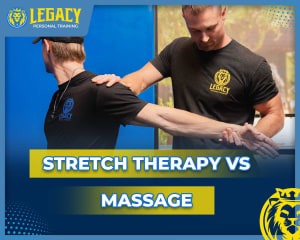
You train hard. You show up consistently. But when your body starts to feel tight, stiff, or restricted, what’s the right move, massage or stretch therapy? While they may look similar on the surface, the impact they have on your mobility and performance is very different. At Legacy Personal Training, stretch therapy has quickly become one of the most requested recovery services. But many people still assume it’s basically the same thing as a massage. It’s not. Let’s clarify the differences so you can make the best decision for your body, performance, and long-term results. At a glance, both services look similar. You lie on a table. A coach or therapist works on your body. You leave feeling better. But the intention and outcome are very different. Massage focuses on: Reducing muscle tension Short-term pain relief Relaxation and stress reduction Acute soreness in targeted areas If you feel tight, stressed, or mentally rundown, massage can be incredibly beneficial. It relaxes your nervous system and provides immediate relief. However, massage typically: Provides temporary results Does not improve joint mobility Does not teach your body how to control new ranges of motion Does not directly transfer into better lifting mechanics You may walk out relaxed, but if your shoulders are chronically elevated or your hips lack mobility, your body often returns to its old patterns within a day or two. Stretch therapy is assisted stretching designed to improve: Range of motion Joint positioning Mobility and movement quality Muscle activation awareness Long-term performance Instead of simply pressing into tight tissue, stretch therapy guides your body into new ranges safely and intentionally. At Legacy, clients remain mostly passive during sessions, but they’re actively engaged through guided breathing and controlled movements. This helps reduce muscle guarding and allows the body to access deeper ranges safely. The goal isn’t just to “feel better.” If you strength train regularly, especially during progressive overload phases, you’ve probably said: “I just feel tight.” That feeling often isn’t just tension. It’s limited mobility or poor joint control. Massage may temporarily relieve the tension. Here’s how: When someone assists you into positions you cannot reach on your own, you expose your body to new movement patterns safely. Over time, this: Increases joint mobility Expands usable range of motion Reduces compensations during lifts Less compensation means cleaner form, safer lifting, and better strength development. Muscle guarding is when your body subconsciously tightens to protect itself. This often happens during heavy lifting phases. Your body creates protective tension, even when it doesn’t need to. Through guided breathing and assisted positioning, stretch therapy teaches your body: “You’re safe here.” That awareness allows muscles to relax in deeper ranges instead of constantly bracing. Stretch therapy is highly educational. During sessions, coaches identify: Asymmetries Rotation limitations Joint restrictions Compensation patterns When you understand what’s tight or restricted, your warm-ups become intentional instead of rushed. Better warm-ups = better workouts. Massage provides short-term relief. Stretch therapy supports: Strength progression Movement efficiency Injury prevention Better end-range awareness Improved lifting mechanics When you feel “taller” or “looser” after a stretch session, it’s because your joints are moving more freely, not just because tension was temporarily pressed out. Massage may be best if: You are highly stressed or mentally rundown You need nervous system relaxation You have acute soreness in a specific muscle You want temporary relief from tightness There is absolutely a place for massage in a recovery plan. It just serves a different purpose. Stretch therapy may be the better option if: Your lifts feel restricted You feel stiff during strength training You struggle with depth in squats or overhead positioning You notice asymmetries side-to-side You want mobility improvements that last You want recovery that supports performance If you’re training consistently and not seeing improvements in how your body moves, stretch therapy may be the missing piece. Both options work. Acts as a mobility primer Improves muscle activation Increases circulation Enhances warm-up quality You’ll still want to follow it with dynamic movement, but it can prepare your joints for deeper ranges during your lift. Enhances circulation to trained muscles Allows deeper ranges because your body is warm Supports recovery Reduces post-training stiffness Many clients schedule stretch therapy on recovery days. If you’ve trained three or four days in a row but still want to move, stretch therapy offers: Active recovery Joint movement without heavy loading Restoration without full rest It keeps you mobile without taxing your system. Think about a knot in your shoulder. Massage presses into the knot to reduce tension. Stretch therapy works around the knot by improving how the joint moves, how the muscle activates, and how the surrounding tissues interact. Instead of repeatedly pressing the same tight area, you retrain the movement pattern that created the tension in the first place. That’s the difference between temporary relief and long-term improvement. As more people train hard and prioritize strength, mobility is becoming a non-negotiable part of performance. At Legacy Personal Training in Scottsdale, stretch therapy is integrated into a complete system: Strength training Mobility development Recovery support Performance progression It’s not just about feeling good. It’s about using the right tool for the right outcome. Choose massage when you need relaxation and temporary relief. Choose stretch therapy when you want mobility improvements that transfer directly into your training. If you’re feeling restricted, stuck in your lifts, or limited by stiffness, stretch therapy may be the missing link in your program. If you’re training hard and want recovery that actually supports your results, ask your coach about scheduling a stretch therapy session. Have questions about health, fitness, or nutrition? Leave a review on the Healthy Living Scottsdale podcast and ask your question—you might hear it answered live on the next episode.Stretch Therapy vs Massage: Which One Do You Actually Need?
Stretch Therapy vs Massage: The Core Difference
Massage Is Tissue-Based
Stretch Therapy Is Movement-Based
The goal is to move better.Why Stretch Therapy Transfers Directly Into Your Training
“I feel stiff.”
“Something feels restricted.”
Stretch therapy addresses the root cause.1. It Improves Range of Motion
2. It Reduces Muscle Guarding
3. It Makes Your Warm-Up More Effective
Better workouts = fewer injuries.4. It Improves Performance Long-Term
When Should You Choose Massage?
When Should You Choose Stretch Therapy?
Should You Schedule Stretch Therapy Before or After a Workout?
Pre-Workout Stretch Therapy
Post-Workout Stretch Therapy
On a Rest Day
The “Knot” Analogy: Why Stretch Therapy Lasts Longer
Why Stretch Therapy Is Growing in Scottsdale
It’s about moving better so you can train harder, longer, and safer.Final Takeaway: It’s Not Massage vs Stretch Therapy
Want to Improve Your Mobility and Performance in Scottsdale?